Forage.

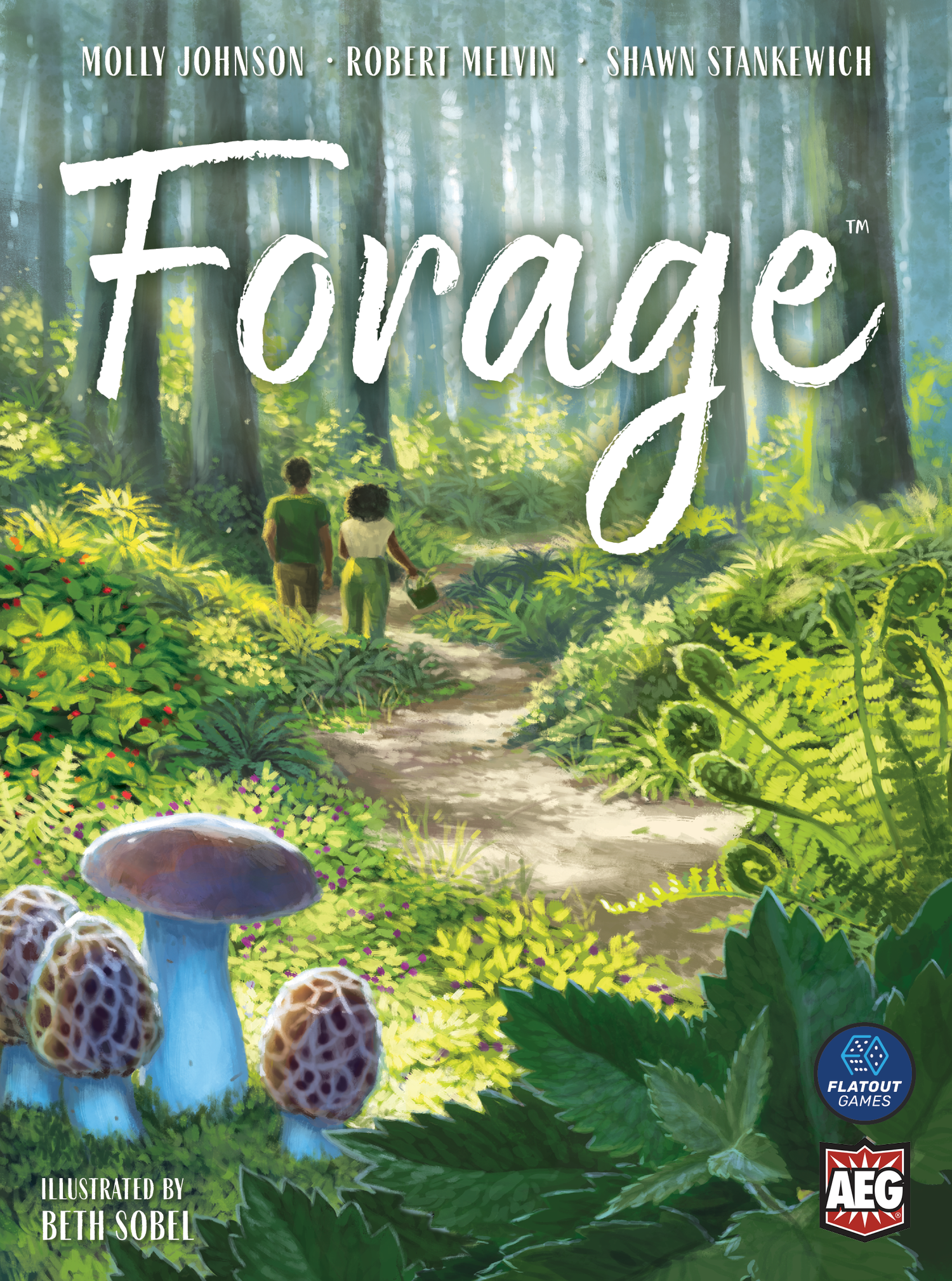
Forage is a new roll-and-write from Flatout Games’ internal design crew, the same folks who brought you Verdant, Point Salad (and sequels), and TEN, where players fill out three types of cards by selecting from a huge set of dice rolled on each of the game’s thirteen turns. As in most good roll-and-writes, you’re trying to chain bonuses and get extra plays, which exist in Forage but aren’t that easy to come by.

In Forage, players try to gain victory points by completing goal cards, spending time to use journey cards, and from bonuses on the cards they’re filling out from the dice rolls. Players will fill out Pantry, Gift, and Exploration cards, gaining bonuses for finishing the cards, and in the case of Pantry and Exploration cards for finishing parts of the cards – sometimes giving a victory point or two. Players also gain and spend time, using it for extra dice actions, extra icons, or to invoke a journey tile that gives a bonus action and/or points.
Each round starts with the roll of eight dice, seven normal ones and one special one that is special because the wood is dark like chocolate, and chocolate is special, especially when it’s dark. Whoever rolls the dice separates them by the symbols showing; if there are any groups of dice with the same symbol, they go to the left of the central foraging basket card, while unique dice go on the right, and the special one goes on the basket card itself. This grouping matters tremendously in how you play the game.

Dice on the left, in groups, can be used for the Pantry cards, which show rows of jars of three different colors, which I believe is always 16 jars per card to complete. Dice on the right can be used as an entire group – including the special die – for the Exploration cards, which show paths between these symbols and bonuses between the paths that you get when you mark off all the surrounding symbols. For the Gift cards, you can use any one group on the left, or use all the dice on the right, again adding the special die if you wish.

Time is the main currency within Forage, and, as in life, there is never enough of it. You start with two time units on your dry-erase card, and you gain a time from completing any card. You can fritter and waste your time in many offhand ways, such as spending two to take an additional dice action as described above, or spending one to add any icon you wish to the dice you selected. The big use of time here is on those journey tiles, which mark the passage of time through the game – you start with three revealed, then reveal one per round. The first ten of those will allow any player to pay a fixed amount of time, three to nine units, for an immediate benefit that may include victory points (9 time yields 12 VP, which I think is the most) and/or the ability to mark off various things on your cards. The last three give you some kind of instant benefit instead as you approach end game. There are also knowledge and experience symbols on your scoring crd that score 1 point apiece, or 5 for each pair (one of each, that is).

If it sounds a little point salady … I think that’s fair, as even after a few plays I still had to put the knowledge/experience part out of my mind to focus just on the cards in front of me. I love the way the dice work, so that you aren’t facing three equivalent choices among the cards, a mechanic that spills over into extra dice actions as well. Completing these cards is pretty hard, though, and that’s where I struggle with Forage: It is not an inherently complicated game, and you will always have something you can do, but either I’m really bad at this or chaining bonuses is quite difficult here, so my plays have been equal parts fun and frustrating.

I do think Forage is a good game, and I would probably like it more if I kept playing it and learned some better strategies to use early in the game. Right now, I feel like I haven’t fully grasped how to play it well, which isn’t usually how roll-and-writes go for me, for whatever that’s worth. It’s a grade B for me, but I admit I could be too low because my brain refuses to cooperate when playing.

Verity.

Verity might be the worst novel I’ve ever read. If it’s not, I am unable to remember one that was worse.

It’s not just that it’s the book I disliked the most, although that’s probably also true. I hated Moby Dick and Naked Lunch. Those books were unpleasant to read, the latter because it seemed to be pointlessly provocative and the former because I don’t care about whales, but they still have literary merit beyond their stories or the authors’ language choices. Verity, which is by Colleen Hoover, is completely devoid of literary merit. It is barely a novel. It is a novel-like substance. It is novel-shaped. It’s about 300 pages of absolute dreck, and the only good thing I can say about it is that it was over fast.

The plot, such as it is, might have made for a good potboiler in the hands of a better writer. Lowen is a struggling writer who’s about to be evicted from her apartment when her literary agent (who was briefly her lover as well) calls her in for a secretive meeting. En route to that meeting – and here’s where the book opens – she witnesses a pedestrian walk into the path of an oncoming bus and get his head smashed like a watermelon on stage with Gallagher, covering her with blood and, one would presume, some of ze little grey cells. A handsome stranger helps steer her into a coffee-shop bathroom and even gives her the shirt off his back.

Naturally, the handsome stranger, Jeremy, is also going to that meeting. His wife, Verity, was a successful novelist, but she’s unable to continue writing after an accident has left her catatonic. He wants Lowen to finish the series Verity had begun. Oh, did I mention that Jeremy and Verity lost both of their twin daughters, about six months apart, to strange accidents? Verity needs the cash, so she accepts the offer and heads to Jeremy and Verity’s house in Vermont to go through Verity’s papers, looking for notes and outlines. She instead finds a manuscript that seems to be Verity’s autobiography, in which she reveals herself to be something akin to Mommie Dearest.

It gets dumber from there, right down to the cowardly resolution, where Hoover essentially refuses to pick any side at all. Besides the thin plot – which, again, could have been something – these three main characters all suck. Jeremy is about as three-dimensional as the parchment paper I use to bake cookies. He’s handsome and considerate and grief-stricken in that brooding way, and also, he really doesn’t seem to have much compunction about flirting with Lowen while his non-responsive but definitely alive wife is upstairs. Lowen makes the wrong choice at nearly every turn, for no apparent reason other than plot convenience, as she is definitely not stupid, and she’s not that naïve, either. Like any author of a mediocre horror story, Hoover needs her characters to do dumb things, so they do.

The writing is the real icing on the dumpster, though. The prose is choppy and the vocabulary is limited, with a slew of sentence fragments, one-sentence paragraphs, and sentences in desperate need of an editor. “To the right are boxes of things accumulated over the years they’ve been together. Some with lids, some without.” An even clumsier example: “I learned very early on that a human is not merely comprised of only one thing.” (Wrong. The whole comprises its parts.) “We have our conscience, which includes our mind, our soul, and all the intangible parts. And we have our physical being, which is the machine that our conscience relies on for survival. If you fuck with the machine, you will die.” That’s four separate paragraphs, along with one of the worst explanations of dualism you’ll ever see. Most of the book reads like a middle-schooler might have written it … except for the sex scenes, which are among the worst I’ve ever read – and I read a lot of science fiction by male authors. “He fed me, and then he fucked me,” introduces one of the first such scenes, which reminds me of the excerpts from Fifty Shades of Grey people would post to show how bad the writing in that series was.

I know this book is very popular, as is most of Hoover’s work, and the movie is already off to a good start at the box office. I say don’t waste your time. This is twaddle. It’s pablum for the masses, but it isn’t even entertaining enough to make up for how low-quality the prose and characters are.

Next up: Ann Patchett’s latest novel Whistler.

Stick to baseball, 10/3/26.

One new piece from me at The Athletic this week, my annual Minor League Prospect of the Year column, with this year’s honor going to Rainiel Rodriguez of the Cardinals.

I’m still mostly on Bluesky, Instagram, and TikTok. And yes, I’m overdue for a newsletter.

And now, the links…

  • The parents of 17-month-old girl gave her raw milk, thanks to a recommendation from her chiropractor (of course), and the girl nearly died of an E. Coli infection. California has done nothing to the unlicensed dairy that sold the toxic liquid. No one even seems to expect the chiropractor to face any consequences; the quack’s office banned the mother from the Facebook group it runs when she explained what happened to her daughter.
  • We all got a good laugh at the clownery of Sen. Eric Schmitt (R-MO) this week when he accused Jack Smith of being at an Atlanta Hawks game when Smith was actually at an Iowa Hawkeyes game. The St. Louis Post-Dispatch’s Tony Messenger uses this to expose Schmitt’s ridiculous state lawsuit against China for supposedly hoarding masks during the pandemic – masks Schmitt claims don’t work, by the way – which is costing Missouri taxpayers millions of dollars.
  • There’s a dengue fever outbreak in Florida, perhaps the worst-equipped state to deal with a public health crisis. Climate change is going to push more of these so-called “tropical diseases” into the mainland U.S. as the mosquitoes that spread them are better able to survive our winters.
  • A 14-year-old boy in England chased a girl who refused to date him through a shopping area and then stabbed her. He received probation.
  • Todd Rundgren got the attention he sought when he claimed that Taylor Swift has ruined music. I’m not a Swiftie at all – I think she might have two songs I like – but this is some serious old-man-yells-at-cloud stuff. The flattening of popular music is driven by technology and by rudimentary capitalism, not by any one artist, who, by the way, is far from the worst out there (like, has he heard Stella Lefty?).
  • Restoration Games has already raised nearly $1.5 million as of Friday morning for its Kickstarter for The Lord of the Rings: The King’s Gambit, the huge, special-edition reboot of 2000’s Star Wars: The Queen’s Gambit. There won’t be a regular edition from Restoration after this one, so if you’re into this game, now’s your chance.

Music update, September 2026.

Lot of big albums coming in October, I think, so September turned into a solid month of new music, with many of these songs coming from albums/artists I haven’t had on playlists this year. This doesn’t even include new albums that came out in the last few weeks from Beck, Blondshell, The Tubs, Gurriers, or Slow Pulp; the first two didn’t do much for me, and I still have to listen to the last three. As always, if you can’t see the widget below, you can access the playlist on Apple Music or Spotify.

CHVRCHES – Roses. I think this is my favorite CHVRCHES track since their second album, Every Open Eye, and maybe since their debut record, which this song really evokes musically. There’s more going on here lyrically than most of their output, even just in quantity – Lauren Mayberry is way more present here, which is nearly always a good thing. I don’t love the production on the chorus, but otherwise this feels like they’re recalling “The Mother We Share” and “Gun” as they lead up to album #5.

The War on Drugs – Who’s That. I can vouch that this song sounds amazing live, having seen TWoD’s incredible show at the Queen here in Wilmington, which was packed because you don’t often see a band this big playing at a smaller venue like that. Every time I see this song’s title, though, I want to say “BROWWWWWWWWWN!”

Moses Boyd feat. Amber-Simone – Criticise. Jazz drummer/composer Boyd announced his second solo album Songs for Sinners will drop on October 30th; this funk-tinged track is a big step up from the first single, “Say Yeah,” and gives me more hope that the album will be a worthy follow-up to the tremendous, boundary-pushing Dark Matter, which gave me my favorite song of 2020, “Shades of You.”

Wishy – Sensational. Wishy’s second album Nature’s Pill ought to be their big breakout, with two incredible singles already in “Lovesick” and “All the Rage” along with a couple of other above-average tracks like this one and “Mona Lisa.” It’s power-pop with a jangly edge to it, fun and funny lyrics, and some great back-and-forth among the vocalists.

Lambrini Girls – Bang Bang Bang. This British punk duo announced its second album, No Refunds, will be out on January 15th; this song has a tremendous, high-octane guitar riff driving it, while Phoebe Lunny’s sung-shouted lyrics are, as always, both witty and incisive.

Anxious – Secret Weapon. This emo-ish band released its second album, Bambi, early in 2025, and they’re back already with two new singles, “Don’t Move” and this one, that sounds more like harder 1990s alternative than the emo tag usually applied to them. (I feel like we’re far enough from the first emo wave that bands doing it now should get a new tag.)

Tom Morello feat. KNEECAP – Unconquered. Morello’s latest solo album Everyone Gets Everything They Want just dropped on September 25th, with some uninspiring collaborations (Serj Tankian’s song is particularly bad), and then this one that seems almost obvious in hindsight given the Irish group’s politics. It helps that Morello provides a strong guitar riff behind them.

Sampa the Great – Simon Says. This Zambian rapper calls herself great, but it’s no lie. “You say all my demons is coming/I say all my demons is dead” feels like a great call-and-response for live shows. Her third album, Nu Zamrock, comes out on the 30th.

Rakim, Kurupt, & Masta Killa – I’m Good. This hip-hop supergroup dropped The Godbody LP on September 18th, and on this and all of the tracks I’ve heard, Rakim towers over the other two rappers.

Tiakola feat. Jorja Smith – Jet Lag. Tiakola is a Congolese-French rapper, formerly a member of 4Keus, while Smith is one of my favorite singers in any genre and just released a new album this summer. This collaboration has her rapping more than singing, with her lines in English and his in French. It’s pretty catchy, with a UK garage beat behind their lyrics.

Locust feat. Natasha Morrow and Neil Halstead – Long Distance Lover. Locust is 60-year-old Mark Van Hoen, an electronic music artist from London, who just released his 13th album, Spectral+, in September. This song features Halstead, guitarist and one of the vocalists in Slowdive; and Irish singer Morrow, whose voice isn’t totally up to the challenge here, although I found the song catchy enough to put on this list.

Adult DVD – Jesus Christ Supercar. A surprising banger that draws on early new wave/post-punk while still sounding reasonably modern. “I thought I was Jesus but the drugs wore off” is one of the best lyrics of the year.

GIFT – Hand to the Flame. GIFT announced a new album, Frenzy for the Thrill, due out January 15th, with this lead single bringing their standard psychedelic-rock approach to a more uptempo beat, with more prominent guitars and a poppier melody.

World News – The Way It Goes. That little note on the last beat of every fourth measure feels like it’s straight out of 1984. They’ve got a great sense of melody, and lean hard into their 1980s influences, with Fader comparing them to Talk Talk and the Smiths. They’re more melodic and upbeat than those bands, though. In Purgatory, their long-awaited (by me) debut album, comes out on the 15th.

This is Lorelei – The Kid with the Crown. I haven’t loved Nate Amos’ solo stuff, but this song kicks ass. It’s like Belle & Sebastian tried to write a bluegrass song.

Sharp Pins – Face of Youth Today. Sharp Pins is 21-year-old Kai Slater, whose songs “are low-fidelity to the point where they often sound as if they’re being played from another room of your apartment.” (Hat-tip to Post-Trash for that quip.) Imagine if early Cloud Nothings was more inspired by 1960s pop than noise-rock and punk.

Beabadoobee feat. Hayley Williams – Nothing to Prove. Pylon might be Beabadoobee’s best album to date; it’s at least as good as her last two records, maybe a little more polished, although that cuts both ways. I have been disappointed to see how much of the publicity around the record seems to focus on her looks, which, who cares? This isn’t 1985 and MTV doesn’t play music any more.

Sports Team – Billy. I loved Sports Team’s 2022 album Gulp! and was very disappointed by their 2025 album Boys These Days; this track, for now a non-album single, sits somewhere in between the two, with more energy than the latter album and more humor, although it’s not quite as catchy as “Dig” or “The Drop.”

Soccer Mommy – Rings of Saturn. One of Soccer Mommy’s better singles, this marks her first new music since 2024’s Evergreen, with a very ‘90s vibe and a vocal line that reminds me a ton of “Tractor Beam” by Snail Mail … with whom Soccer Mommy is touring this fall.

Morphine – Cocoon. Morphine seemed like they were on the verge in the 1990s, with “Thursday” and “Honey White” gaining some crossover success, when lead singer/bassist Mark Sandman died after suffering a heart attack while performing on stage in Rome in 1999. The remaining members have completed the album Cocoon, started in 1998 but never finished, and will release it on December 4th, marking the first album of ‘new’ material from the band in 26 years. Totally unrelated, but I saw some pictures of Sandman when reading about the new album and going down a bit of a Morphine rabbit hole, and I keep thinking, man, he looks like he might have had Marfan syndrome. I don’t know anything about this stuff, so take that with a grain of salt.

Kiwi Jr. w/Protomartyr – Landscape with Limousine. I did not see this collaboration coming, but it works, producing a song that sounds a lot like … hard-rock Pavement?

Gilla Band – Alogia. I’m still working through Gilla Band’s album Pugnello, which has received glowing reviews, but is a difficult listen; I believe Paste called them “post-punk” but they’re borrowing from way more traditions than that, including early industrial like Throbbing Gristle.

Lost in Kyiv – Tróia. Theycall themselves“post-rock,” which I assume is because nobody wants to be “prog rock” in 2026 because people might think King Crimson, and that’s not the vibe here at all. It’s closer to prog metal, inspired by Russian Circles, with some Wheel or Porcupine Tree or even Dream Theater. Their latest album We’re All Going to Be Fine came out in June; this track is off the Pelagic Records compliation album The Dungeon Tapes.

I Built the Sky – The Start of Something Beautiful. I Built the Sky is the project of Australian guitar wizard Rohan ‘Ro Han’ Stevenson, who just released another album of progressive instrumental metal called Promise Me You’ll Thrive. It’s heavier than the sort of instrumental guitar records I loved as a teenager – I’m thinking of Steve Vai’s Passion & Warfare in particular – but I love both the virtuosity of his playing and the ambition of the songwriting.

Coroner – The Favorite Game. This isn’t a new track, but it was actually new to me because it only appeared on their 1995 compilation album, also called Coroner, and I really just know their albums (primarily their last two before their breakup, Mental Vortex and Grin, two of my favorite metal albums ever). This comes off the upcoming EP Ex Nucleo (The Remastered Extraction), which will include five tracks from Coroner.

Godflesh – Master and Slave. The opening track from Godflesh’s latest and penultimate album, Decay, is mostly instrumental, and reminds me of their debut album Streetcleaner but slower and sludgier. Singer/guitarist Justin Broadrick, who wrote and produced this entire album, underwent abdominal surgery this spring and is no longer able to sing live, so Godflesh won’t be touring, and this entire album has about 150 total words of lyrics.

Sleep – Arrival of the Industry Ships. The longest of the five tracks on Sleep’s newest album Hempispheres is deeper and doomier than the rest; the album has received middling to poor reviews for the mediocre lyrics (I get that, but also, no one is listening to Sleep for the lyrics) and, I think, because Matt Pike isn’t the guitarist any more. I’ve written this before, but given his embrace of antisemitic conspiracy theories I’d rather have Sleep without him.

There Is No Anti Memetics Division.

There Is No Anti Memetics Division starts with a mind-bender premise, and most of the book is brilliantly creative, built around a world where memes – not the kind of memes you might associate with social media, but memes as ideas that are noncorporeal, sentient identities – are present in our world, and some of the most dangerous ones are capable of making people forget they ever saw or heard them. It’s one of the most Philip K. Dick-like novels I’ve ever read, and for about three-fourths of its pages, I thought it was going to be my favorite novel of this year’s Hugo candidates (it made the longlist). Unfortunately, author Sam Hughes, who writes as qntm, chose a deeply unsatisfying resolution that loses the frenetic pace of the rest of the book while also breaking with the themes he seemed to be tackling.

The novel sort of centers on Marie Sheridan, who is, as the novel starts, the head of the Anti-Memetics Division of the Organization, which has the task of fighting and controlling these Unknowns, which range from the mostly harmless (a rock that is also an ancient god and has one power, making people forget how to ride a bicycle) to apocalyptic (the entity that she will end up battling in the book). Most Unknowns escape the notice of the majority of people who encounter them, sometimes to the point of being invisible to people who aren’t trained to see them or born with such an ability. Marie’s husband Adam happens to be one of the latter group, which turns out to be useful when Marie has to make him forget her to try to save him from that particular Unknown that is threatening to end the world.

I confess that I find Hughes’ bio itself to be pretentious as hell, beginning with the pen name ‘qntm.’ The author bio he uses in the book and online says that ‘his preferred writing technique is to start from an interesting hypothetical and drive it to breaking point and far beyond.’ I’m not even sure what “and far beyond” means in this context. It’s just bloviating. And I will say I don’t think this novel doesn’t anything of the sort. However, if you feel that’s the best descrtiption of your writing style, great. Show us. Let your work do the talking.

I mention this because for the vast majority of this book, I was on Hughes’ wavelength. The premise is crazy, and the world he’s built barely holds together, but it was working, thanks to a combination of incredible situational humor and closed plots that are internally coherent. Once the bigger story gets going, however, Hughes keeps growing the plot and the stakes, yet doesn’t have a way to resolve it that obeys the rules of the game that he’s laid out to that point in the book.

The first three or four chapters feel like short stories written in this universe, tied together by setting and a character or two, but without a unifying narrative. Once those are done, we shift into the longer story about the Organization’s fight with this one seemingly invincible Unknown that is so powerful that no one remembers seeing it, and any study of it or attempts to plan to fight it result in the person doing so forgetting everything about it. The Organization has to build a memetically-sealed lab so they can at least house something like research about this enemy.

I was pleased to see that I was far from the only person who felt this way about the ending, even among fans of the genre. The book grew out of writing at the SCP Foundation, a massive collaborative storytelling project that, hours before I wrote this review, is going to see some of its works adapted into an anthology film by Neon, for which Variety credits the success of this year’s film Backrooms. There’s probably some more good stuff in there, but a strong short story or set of them doesn’t always translate to the longer form unless the author(s) can stick the landing. Hughes – or qntm – couldn’t.

Next up: I’m actually reading Verity, by Colleen Hoover, because of the movie coming out and some other reasons, and it’s one of the worst things I’ve ever read. The prose is hilariously bad. But after this I’ll move on to Ann Patchett’s latest novel Whistler.

Kronologic Cuzco 1450.

Kronologic: Cuzco 1450 (buy from Amazon · Miniature Market) is the second game in the Kronologic series of competitive logic-puzzle games that started with 2024’s Kronologic: Paris 1920, which I liked quite a bit other than worrying that the puzzles might be too easy for older/more experienced players. This second game comes with a new theme and 15 new mysteries to solve, coming in three “scenarios”, with the first two fairly straightforward while the third is kind of bananas.

If you’re unfamiliar with the Kronologic series, each case revolves around six characters moving around a map of six locations across six time periods, and you have to figure out something specific, such as (in the first five cases here) what one location was visited by only two characters in total, and when those characters were there at the same time. On your turn, you get one clue of your choosing, which you get by combining a location and a character or a location and a time period. All information in the game takes the form of character-time period-location; you can combine either of the first two with a location to get the missing bit.

The location cards have grids of symbols on the back, which you’re not allowed to look at directly; instead, you take the character or time period overlay and place it over the location card to get two clues. One clue is public, a number that tells you how many characters in that location at that time, or how many times that character went to that location, that you must read out loud. The second clue is private, and will tell you one time period when the character was in that location, or one character who was in that location at that time period.

Each case starts out with a map showing you all characters’ locations in the first or sixth time period and some paths between locations that are blocked or are one-way. Characters can’t stay in the same location in consecutive time periods, so you know they must move and can try to deduce their locations in time periods before/after known locations. The goal is to get enough clues to deduce that case’s solution.

The first two scenarios here are familiar enough in format that anyone who’s done some logic puzzles should get the hang of the game fairly quickly. The third scenario is where it gets much harder: characters move in ‘dances,’ sequences of movements, and in the last few cases you don’t even know which character moves according to which dance. I mentioned my concern that the Paris box wasn’t hard enough. I do not have that concern with the Cuzco box. If the first ten cases aren’t hard enough, the last five really should fit the bill.

There is an expansion for the Paris game called Panic at the Opera & the Cursed Lovers, with 10 new cases, but I haven’t played it (it requires the original, which I no longer own) and it’s only available in a few places, like Noble Knight Games, while it’s out of stock at Miniature Market.

Audition.

A middle-aged woman gets a note from an attractive young man about half her age, who asks her to have coffee with him, where he reveals to her that he believes she might be his mother. In the first telling, she says that’s impossible, but ends up helping him try to start his career in theater. In the second telling, he isn’t just her son, but he grew up with her, and is merely coming back home to live while he gets his career going.

In Audition, Katie Kitamura explores her main character-narrator twice over, and the result is that the character changes, but our perception of her changes even more, not least because of what western societies tell us about motherhood and women in general. The first half, where the young man isn’t her son, shows her as colder, less empathetic, more calculating, while the second has her warmer, but also more anxious and submissive. One of this year’s Pulitzer finalists, it’s a terse exploration of how we* see women based on their roles and the actions of the men around them.

* Especially me, a man raised in an even more patriarchal era than our own, and raised around a lot of traditional gender roles and stereotypes.

Kitamura’s prose is sparse, almost clinical, especially in the first half of the book, where Xavier (the young man) isn’t her son because she has never carried a pregnancy to term. In that story, she’s been unfaithful to her husband Tomas many times, so when he spots her with Xavier in a restaurant, he might suspect this is her latest lover. The combination of her treatment of Tomas and her rational, almost emotionless reaction to Xavier’s appearance and the possibility of an alternate history comes across as even more surprising because she’s a woman – even though that clouded lens is ours.

Right around the midpoint, Kitamura begins part two, which might as well be a separate novella, as it opens with Xavier returning home to live temporarily because of his demanding new job as an assistant to the director of a play in which his mother is acting. That he is her son is assumed – there’s no transition to this new scenario – and only as the story unfolds do we see how her character is changed, along with that of Tomas, who is the philanderer in this half. Now the narrator is anxious, eager to please both her son and her husband, and becomes submissive to the point of reducing her importance and presence in her own apartment.

It seems like Kitamura is exploring how becoming a mother changes both a woman’s actual character – the narrator in part two isn’t a tradwife, but I couldn’t help but think of that misogynistic trend – and how everyone around her treats and sees her. Kitamura’s thumb is on the scale here, of course, but she’s playing fair with the parent’s instinct to give up things for their children, even if it’s to the point of giving in when they shouldn’t. (I have struggled with this myself, so I was especially primed to see the second story this way.) The stereotype that mothers are caring and warm while women who aren’t mothers, regardless of the reason, must be cold and lacking in empathy is reasonably pervasive in our society, and Kitamura pushes both of those generalizations to reasonably extreme points to expose them.

I would have picked Audition over Angel Down for the Pulitzer, although I think Audition’s prose, while direct and quick to read, lacks some of the beauty or energy found I would hope to see in a winner of any such literary prize. Her language is more clinical in the first half, while she doesn’t entirely shed that in the second half; if you love the prose of Ernest Hemingway or Raymond Carver, you might connect with Audition more than I did. I engaged more with the novel’s philosophical aims and the thought experiment within than I did the language or even the dual main character, although that ultimately was enough to get this over the line for me.

Next up: I’m about halfway through Eric Ambler’s Passage of Arms.

Stick to baseball, 9/26/26.

One column at The Athletic this week, my hypothetical award ballots for the five major player awards other than NL Rookie of the Year, for which I actually voted this year. My minor-league player of the year column will run tomorrow (Sunday).

Plans for my free email newsletter this past week were derailed by a few things, not least of which was me losing a day and a half to getting my flu & COVID shots. For socials, I’m still mostly on Bluesky, Instagram, and TikTok. I’ve noticed an uptick in folks trying to reach me via DMs with baseball questions – I can’t possibly answer all of the individual questions I get, but I do answer the majority of questions I get in public spaces, like the comments under my Athletic stories or on Bluesky.

And now, the links…

  • Mike Rogers, the Republican candidate for the open Senate seat from Michigan, claims he worked on an auto-plant assembly line helping build Chrysler LeBarons, using that as a way to position himself as someone who understands Michigan workers. The UAW says he’s lying: He worked at an aftermarket facility that modified cars, never worked at any Chrysler factory, and was never a UAW member.
  • A new UN report says that women in Gaza are facing heightened risks of sexual violence as a result of the war, due to the breakdown in the societal order. The Jerusalem Post story I linked noted that the UN report doesn’t mention Hamas’ role, which seems like a large omission for reasons they explain in the article.
  • Utah Republicans are subverting democracy there, overruling the voters and setting up extralegal courts to avoid giving Democrats a single Congressional seat from the Mormon-run state. Some LDS women are fighting back.
  • A group of researchers are suing NIH over the blatantly political policy of screening grants for anything that hints of DEI or woke or whatever bogeymen scare the Trump Administration.
  • The same AI-detection tool, Pangram, has also ruled that an acclaimed novel by Haitian-Canadian author Thélyson Orélien was likely AI-written, causing the Prix Goncourt committee to remove the novel from its shortlist. The case is more complicated, in part because the author writes in French while Pangram was trained on English texts, and because of subsequent discoveries that Orélien plagiarized content in articles he wrote over a decade ago.
  • DoorDash spent $1.4 million in the NYC mayoral race last year, most of it to a super PAC that ran disgusting anti-Islam ads targeting Zohran Mamdani. Turns out they did it to try to avoid consequences for wage theft, as Mamdani’s office just settled with the company for $131.5 million.
  • A measles outbreak that began earlier this year in Bangladesh has killed over 1000 children since the spring. This outbreak isn’t due to anti-vax propaganda, but due to poverty, where malnutrition weakens the immune responses even of vaccinated people, and the country’s extreme population density, which helps the highly contagious virus spread.
  • What came before the Big Bang? We’ll never know, of course, but Scientific American talks about how physicists come up with theories about it.
  • The mother in that viral clip at a Giants game, where she was carrying her baby and a substantial amount of food while no one appears to be helping her, wrote a response to the online reaction, where she defends her husband and explains that they’ve even received death threats over the video.
  • New Order/Joy Division drummer Stephen Morris spoke to Vulture about the best songs by those two bands to help promote the release of the 16-CD Eternal (Live) box set of previously unreleased live Joy Division concerts.
  • The New York Times covers two men in England who are doing a podcast about their efforts to learn and play a board game called The Campaign for North Africa, which is known for being abstruse, extremely detailed (Italian units get a “pasta ration”), and long enough that few, if any, have ever finished it. There is at least one user on BGG who says he has finished the game, and I see no reason to doubt him.
  • Two pretty big Board Game Kickstarters this week: John D. Clair’s Electrify, co-designed with Ian Hutchinson, has some shared DNA with Clair’s Space Base. They’re both engine-builders, but this game has less luck than Space Base, at least in the base game.

A Drop of Corruption.

Robert Jackson Bennett won the 2025 Hugo Award for Best Novel with his fantasy/mystery mashup The Tainted Cup, which introduced the world to Ana and Din, an eccentric (to put it very mildly) detective duo who operate in a world that combines medieval trappings with an alternate science built around biohacking and the exploitation of massive and deadly sea creatures called leviathans. The story was solid, if a little more convoluted than that of the typical mystery novel, while the two main characters were the novel’s biggest strength, and the setting was innovative and curious enough to make me want to spend more time within it.

Bennett has written two more novels in the series already, the second of which, 2025’s A Drop of Corruption, was nominated for this year’s Hugo, losing out to The Everlasting. As in the first book, we have Ana and Din working to solve a murder that is hard to fathom and that will ultimately expose a broader conspiracy of graft, betrayal, and, of course, corruption. Set in the neighboring kingdom of Yarrow, which Ana and Din’s native empire Khanum will be taking over in an arrangement that sounds similar to the transfer of power in Hong Kong, the book goes deeper into the weird science that powers this fictional world, and the very bizarre ‘enhancements’ people within it use to do this difficult work.

Ana is the Sherlock Holmes/Nero Wolfe here, a savant who is nearly always blindfolded because she says the visual stimuli of the world are too much for her senses to handle. Din is her faithful assistant, more sagacious than Dr. Watson and more serious than Archie Goodwin, and has himself been enhanced as an engraver who can record things he sees in his mind, as if he had an eidetic memory. Their partnership, awkward and tentative for most of the first book, is more solid and more fluid here, so we step almost directly into their work to solve the first murder – which, mild spoiler here, gets solved far sooner than you might expect because of the way it expands outward into a larger story.

Again, the characters are the real thing here, although in this book Bennett has dropped more clues that might help readers piece together the ultimate solution. (The intermediate one I just mentioned isn’t solvable in that way.) Din gets more screen time than Ana, and it helps flesh out his character more, although if you jumped right to this book without reading the first, you might think Ana is two-dimensional and a bit of comic relief when her oddness is inherent to her character. One of the new characters introduced here, Malo, who has an enhanced olfactory sense, is a strong comic foil for Din, and balances his overly serious manner with her sarcasm.

The setting was what really sucked me into A Drop of Corruption. I’ve played a handful of role-playing games, almost entirely computer ones with a little D&D and its ilk in high school, and I would absolutely play the hell out of a roleplaying game set in this world – especially Yarrow, which is richer and stranger and more foreboding than even Khanum, with political intrigue and what sounds like a massive grey-market economy, along with a people hostile to almost any stranger. Fantasy novels almost always seem to involve magic on some level; Bennett replaces that with his science, which involves the use of plants and fungi to alter people and even create buildings along with the chemical enhancements that many of these characters have undergone. It’s highly imaginative, yet also coherent enough to work with the story rather than detracting from it.

The story is overlong, but the core mystery and its resolution are tighter than that of the first novel, and there are definitely more clues to catch if you’re that sort of reader. (I wish I was, but I am not.) The first murder is a locked-door mystery, part homage, part parody, and that’s about the only thing I sort of figured out here – how it was done, but not who did it. Bennett’s ambition in his plotting works for and against him, making the narrative broader and more interesting, but resulting a book that’s quite long for the genre. I’ve read a few hundred mystery novels by myriad authors and have read very few of this length, mainly by Anthony Horowitz in some of his novel-within-a-novel works. I was pulled through the book quickly – it’s 450 pages and I read it inside of six days – as much because of the characters as my desire to find the solution to the story.

Bennett also slips in a little social commentary here that the first novel lacked, some obvious (hey, slavery is bad!), but some more timely, such as Din’s family story that serves as a metaphor for the crushing pattern of medical debt in the U.S., and the main plot’s exploration of what happens in a world without regulations. Yarrow is an absolute monarchy, but Khanum is also an autocracy, and Bennett should continue to explore what that means for his main characters, who, for now at least, serve its emperor.

I will confess I’m glad to see the next book in the series, A Trade of Blood, came in under 400 pages. I’m a fan, and would have read the third book regardless, but I’ll be happy to see Ana and Din get to the point a little more expeditiously. As for this year’s Hugo, I’m fine with this book being on the shortlist but not the winner; it’s not as good as The Incandescent or The Everlasting but I’d probably put it ahead of Death of the Author.

Next up: A book off the Hugo longlist, There Is No Antimemetics Division, by Sam Hughes, who writes under the pen name qntm.

Canal Houses.

I’m a little bit of a sucker for games that have you building colorful houses. I don’t know why they speak to me so; they might just remind me of places I’ve traveled, including Italy and some places in the Caribbean. Walking in Burano is probably my favorite of these, and I just reviewed Tenby, which is a little more complex.

Canal Houses is the first English version of a Dutch game first published as Grachtenpand in 2024, asking players to build pastel-colored houses along a canal in Amsterdam. Houses all start with a shop on the ground floor, any number of window cards you’d like, and ideally a roof on top. You gain points from the shop and roof cards if their buildings meet the criteria shown on those cards, while the window cards have the four features – cards, birds, flags, and flowerpots – that appear in most of those criteria. The game ends when someone plays their fourth roof card, at which point you score all shops and roofs you fulfilled, take 1 point for every flowerpot, and then give 4 points to the player with the largest contiguous block of cards of the same color.

It’s also a card-drafting game, so you’ll start with a hand of three cards, drawing one from the deck of your choice, then playing any of the four cards you hold, after which you pass your entire hand to your left. You must build upward; each building must start with a shop, and then windows (you could build without one, but it would score nothing), and then the roof. Once you’ve placed a card, you can’t move it, and a building with a roof on it is permanently finished.

I don’t like the term ‘cozy’ in board games or mysteries, but if you know what that word means in this context, sure, Canal Houses has it. It’s light, very fast (you place cards simultaneously), and the only player interaction within the game is when you pass the cards. There’s a two-player variant that’s more directly competitive, skipping the card-drafting aspect, where you also can’t build a roof unless the building fulfills its requirements; I haven’t tried it, but I think I might prefer that with two players. (Mysteries can’t be “cozy.” Someone’s been murdered. Maybe multiple people. That’s not “cozy.” That’s just shit writing.)

I do think Canal Houses is a great family game – it’s very quick (15-20 minutes), and quick to learn or teach. It does have a ceiling, pun intended, because there are so few ways to score, and the window cards have plenty of those icons on them. It becomes just a medium challenge to fulfill your shop/roof criteria, unless someone is able to get their fourth roof down quickly to speed the end of the game. I love the packaging as well – it’s a small, narrow box that will barely take up any space on the shelves. It’s a solid grade B for me, a filler game I’ll gladly keep and throw in the bag on trips.

Designed by