For the Emperor.

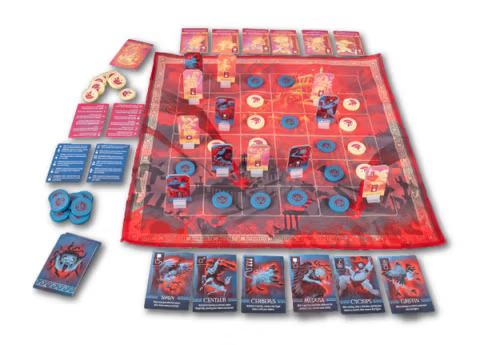
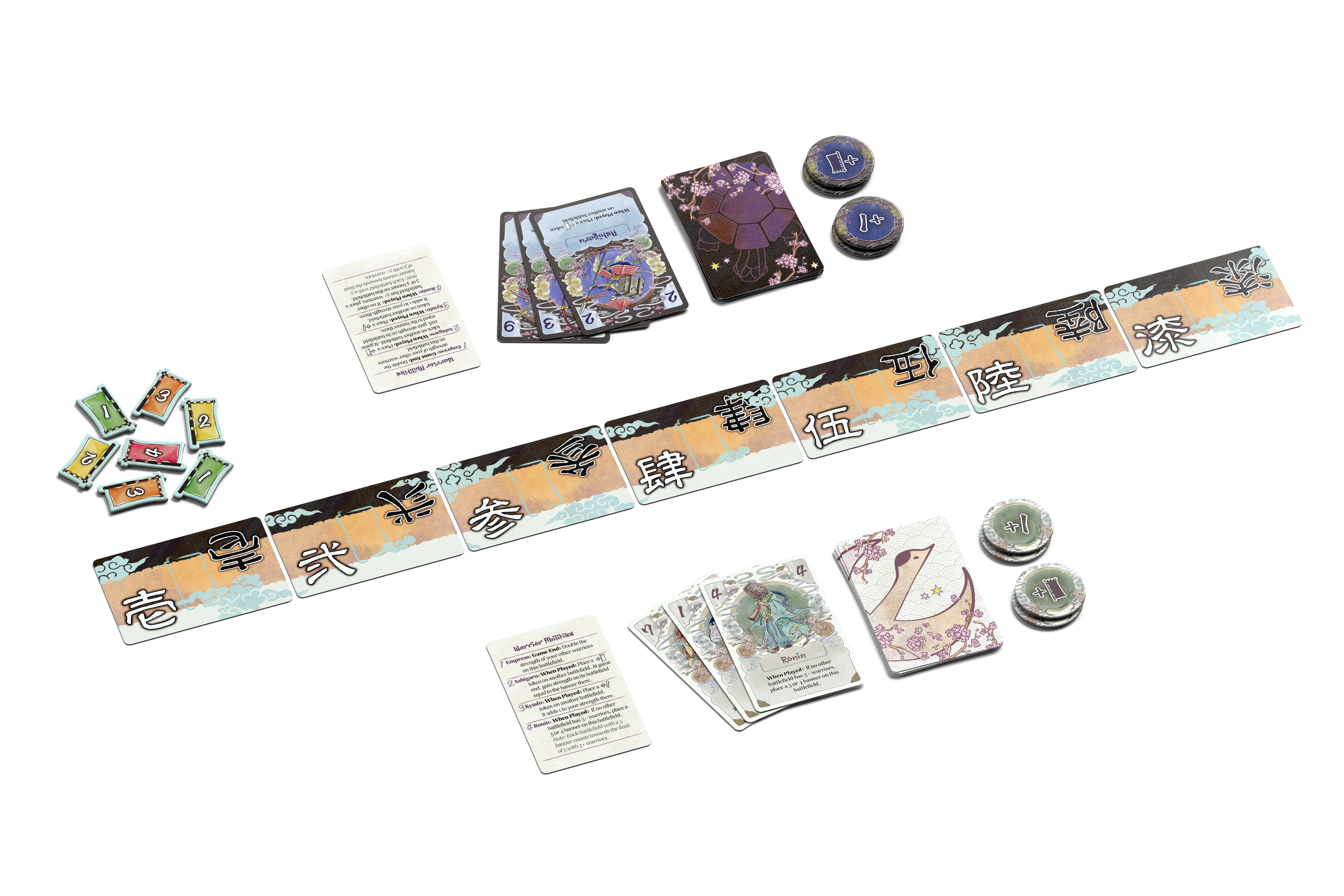
For the Emperor is another tiny-box game from Allplay, part of their line of games in their smallest packages with a list price of $9. It’s a dueling/capture-the-flag game that adds the twist of limiting the number of cards players can play to each flag – but those numbers aren’t assigned to the flags at the start of the game, only appearing as the game progresses. It’s a very good idea that the game doesn’t fully execute.

Players in For the Emperor fight to control seven battlefields between them, with those battlefields all the same when the game begins. Each player has a deck of nine warrior cards, numbered 1 through 9, each with a unique power, with a hand size of three during the game. There are also banners, separate from the battlefield flags, numbered 1 through 4, that will help determine when flags are full. On your turn, you play one card to any flag that isn’t ‘full,’ then use its power if you so desire. After that, you check all flags to see if any of them has a number of warriors equal to the highest numbered banner that isn’t already on a battlefield. You’ll place banners on battlefields (flags) in descending order until you don’t have any more matches, which starts to clamp down on where you can place your cards – once a battlefield is full, meaning it has as many cards as the number on its banner, you can’t place there unless someone uses a power to pull a card back. You also can never have more than three battlefields with three or more cards.

The result of those rules is that your choices narrow quickly, making the game seem to speed up as it progresses. The beginning is a little slow, almost amorphous, because you’re just putting cards down without a ton of information to guide you – nothing’s restricted, you only have three random cards in your hand, your opponent doesn’t have many cards down either, so you both sort of throw stuff out there to maybe set up a better endgame situation given the cards you happened to draw. That makes the endgame more exciting because you’ll be resolving flags more quickly, but also means your moves later in the game are more obvious. There will usually be one clear, optimal move, as some flags will be out of reach even if they’re not resolved.

When all battlefields are full, you compare the strengths of the cards on each side, also counting any tokens you added as a result of card powers. Higher total strength wins the flag; whoever controls the majority of flags wins the game. My plays were all very close, and the game does truly play in less than 15 minutes.

The art is from the Japanese artist Sai Beppu, who’s also illustrated some other great Allplay games, as well as some other games that originated in Japan (Trio/Nana, No Loose Ends) or have Japanese themes. It’s probably the game’s strongest attribute, as the cards go beyond the usual Edo-inspired style of most Japanese-themed games, with more whimsical, cartoonish (in a good way!) drawings of the various warrior characters.

I filed a review to Paste for another capture-the-flag game, 2024’s Space Lion, that will run this week or next, and while they’re very different games in complexity and components, at the end of the day they’re both fundamentally like Air Land and Sea, which is itself a kicked-up version of Battle Line. You’re playing cards of varying powers to the flags between you, trying to control a majority of them or some other combination to win the game. I’m very interested in games that follow that template and add something new to it, but they have to flesh out that vision in the game play. For the Emperor does give that new twist, but the way it’s implemented here, it ends up feeling rote.

I’ll get to it soon, but of the Allplay Tiny Box series, my favorite so far is Soda Jerk, which truly lives up to its name – you win by being mean.

Darwin’s Journey.

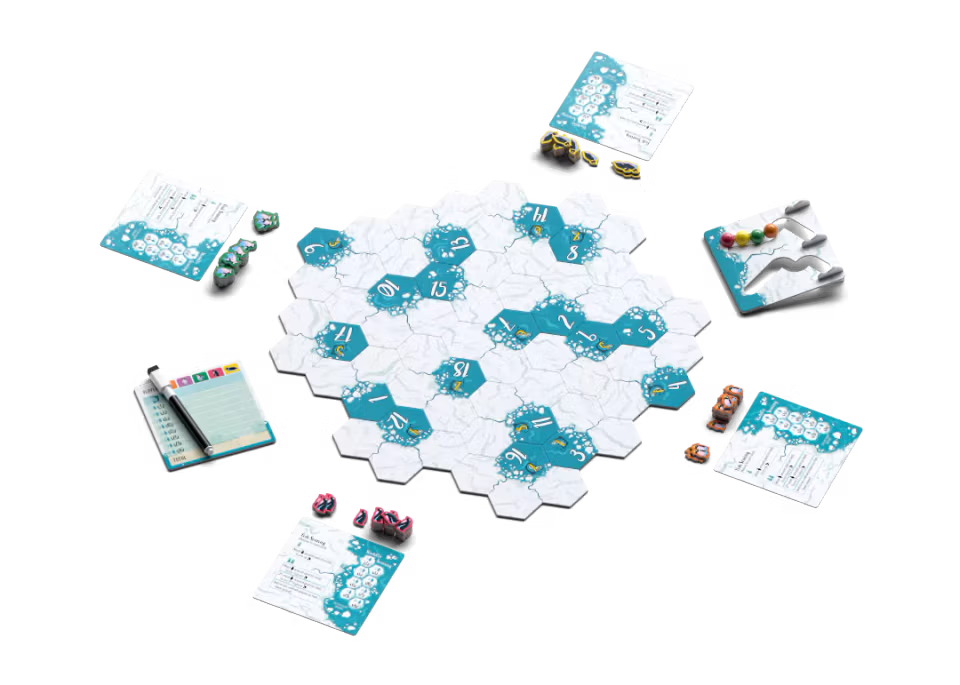
Darwin’s Journey is one of the greatest complex board games I’ve ever played – although I’d call it more medium-heavy than heavy – with its incredible balance of various mechanics, strategies, and even a little player interaction. It first came out in 2023 and has since soared into the top 100 overall on BoardGameGeek, a list that skews towards heavier games, while also jumping on to my own top 100 at #16 this November, the highest new entry of any game this time around. I’ve owned the game for probably two years, having picked it up on Prime Day in either 2023 or 2024 for half off, and also love the fact that the box is half the width of any other game of its playing weight I own. (It’s out of stock right now at Miniature Market, but Noble Knight has some used copies.)

Designed by Simone Luciani*, who has three games on my top 100 (Grand Austria Hotel is #17, Tzolk’in is #57), and Nestor Mangone (Masters of Renaissance, last year’s Stupor Mundi), Darwin’s Journey is a worker placement game at heart, asking players to place their four crew members on various action spaces to move their ship, place and move explorers on three mini-maps, gain ‘seals’ to give those crew members more abilities, place stamps for ongoing rewards at the end of each round, deliver specimens to the museum or research ones already there, and more. There are countless opportunities to chain your actions as the game progresses, and you can even add a fifth crew member if you complete a gold-level objective. There are also objectives for each round, plus end-game objectives, with two (one gold and one silver) given to each player at the start, then more available as the game goes along. You also have to make sure you have enough cash on hand, because taking actions nearly always costs at least one coin. There’s a lot going on here, to be sure, although I think the turns are so simple – and your options become more limited within each round as you have fewer workers left to place – that the game play isn’t that complicated.

The rounds are marked by the progress of the HMS Beagle, and that’s one of the few places in this game where the actual history of Darwin’s voyage intersects with the mechanics. (It’s still better at that than the acclaimed In the Footsteps of Darwin, a much inferior game to this one in every way.) You lose points if any round ends with your personal ship behind the Beagle’s position, after which it moves forward to the next marker on its path.

Within a round, each player will place one worker per turn, based in part on the seals (skills) that worker has. You start the game with four workers, one with a wild seal, and then three others with seals you’ll choose in a crew-card draft before the game. The seals represent ship movement (blue), explorer movement (green), stamps (yellow), and more seals (red). When the game begins, there’s one available space for each color of seal, and each of those spaces holds an unlimited number of workers. Once there’s one worker anywhere on the blue/green spaces or the red/yellow spaces, however, placing another one there will cost 2 coins (or 3 in a two-player game). Players can unlock further, more powerful action spaces under each of those four by paying the unlocking cost to place a ‘lens’ on those spaces, making them available to all players – although anyone else has to pay you a coin to use yours. There are six special action spaces that change each game, two of which are available at the start while four are locked. You can also go to the museum to submit or research specimens, go get another objective tile and gain some coins, or go move up in the turn order and gain some coins. If everything’s unlocked, which I don’t think is technically possible, there would be 24 possible action spaces by the end of the game; I think the maximum is actually 22, and I’ve never seen that many in an actual game.

Darwin’s Journey also offers players all sorts of … not quite mini-games, more like side quests that carry real bonuses. You start with 12 stamps in three sets; if you send out all four of a set, you get a bonus. Explorers can place tents on certain spaces on all three maps; you get five of them, and after the first one, each subsequent one you place gets you a bonus. Each crew card you drafted at the beginning has a specific set of five seals shown on it; if you get all five of those seals on one worker’s row, you can assign that card to that worker and get the bonus shown. Getting five seals on a worker also gets you three points at game-end; getting the sixth gets you seven points, and having at least four seals of a certain color gets you an additional benefit when you use that worker for that action. Still with me?

The game goes five rounds, after which you do the end scoring, adding to points you gained during the game from each round’s objective and from points you picked up with your explorers. You score all of your personal objectives. Then you score the research track: every time you submit a specimen, you gain some research points and/or coins, while you can also move up the research track via exploration and occasionally through a special action space. You count the completed rows of specimens in the 4×4 museum, add two, and multiply it by the highest number your marker has passed on the research track; it’s the weirdest part of the scoring by far, but the point gains here can be substantial, easily a quarter or more of your total. I’ve seen winning scores over 200 points, and I have won a game with only about 155 or so.

I’m worried I’m not selling this game enough: It’s fantastic, easily one of the best complex games I’ve ever played, behind only Great Western Trail on my top 100, one spot ahead of Grand Austria Hotel and four spots ahead of Agricola. GWT is a little more accessible, I think, but it has a small deckbuilding element, which is one of my least favorite mechanics. Darwin’s Journey is more forbidding, and getting all of the parts to work together in your head is a real challenge – and even after many plays, I’m still not great at it, because my preferred strategies may not work as well with the specific actions and maps and other facets specific to that game’s board. If you pulled both games out and asked me which one I’d want to play, I’d have a hard time choosing.

* I actually haven’t played Luciani’s highest-rated game, Barrage, which I’ve heard is amazing and quite brutal in its interactive elements. I hated Rats of Wistar – literally got up mid-game at a First Look demo at PAXU and left, although part of that was one of the other players was insufferable – and I would say I like but don’t love Lorenzo il Maginifico, preferring the card-game version. He also co-designed a new version of Railway Boom with Hisashi Hayashi, who won the Spiel des Jahres last year for Bomb Busters and designed the excellent Yokohama games. As always, forza azzurri!

Menagerie.

Menagerie comes from the designer collective known as Prospero Hall, which was acquired by Funko Games in 2019 but then effectively shut down when Funko sold its games division to Goliath Games in January of 2024. There were a few releases last year that were probably already completed when the sale took place, so this is the first new game we’ve had from Prospero Hall since late 2024 (the Only Murders in the Building tie-in game), and one of fewer than a half-dozen in the last eighteen months.

That makes it all the more disappointing to report that this game just doesn’t work. It feels unfinished, with moves almost automatic and no real strategy beyond collecting cards in the same colors you already have. The art is fantastic and the cards are high-quality, but beyond that, I don’t see anything here.

Players in Menagerie, which has the unwieldy full title Menagerie: Unlock the Wonders of a Miniature World, are collecting insects for their collection. Each player has three rows in their terrarium and must choose a different one on each turn into which they will place the insects they select. Then they get to pick two adjacent insects from the six on display and place them in that row, possibly using one of the relatively powerless powers from the symbols on the cards to move an insect, take an iridescent crystal, or break the adjacency requirement. Play continues until someone fills their terrarium with 15 cards, at which point you score.

The bulk of the points come from sets of the same color within a row, with the biggest bonus coming from getting all five cards in a row to be the same color. Each player also gets one private objective card to start the game, and leaning into that can also produce significant points. There are also some small point awards for getting sets of the same symbol within a row.

There is nothing to do in Menagerie aside from taking two cards of the color you want for that row if at all possible. You pick the row before the turn, so you can see what cards are available, and you can pick the row best suited to hold those cards. You can’t refresh the display, which seems like the most obvious power to give a player. It’s just the luck of the draw, and if you’re playing with just two players, you can plan ahead another move or maybe even two by anticipating what the other player might select.

I was a little surprised to see a game this thin come from Prospero Hall, as the group made a strong name for themselves for producing highly thematic midweight or medium-light games for family play, games like Pan Am, Horrified, and Villainous. I didn’t like the last Prospero Hall game I reviewed either, the 2023 game based on the film Rear Window, and looking back through their catalog, the last game of theirs I played and liked was 2021’s The Rocketeer: Fate of the Future. Maybe the makeup of Prospero Hall has changed, or different people are taking the lead, but Menagerie makes me think that their brand isn’t what it used to be.

Menagerie came out last August and remains a Barnes & Noble exclusive, which you can buy here.

First Class Letters.

First Class Letters is a light party game of wordbuilding, taking bits of Scattergories, Boggle, and other similar games in a simple format where you’ll play seven one-minute rounds, trying to create the most valuable word you can in each round based on the rolls of four dice. Three of the dice will show letters you want to use, while the fourth, the red die, has a forbidden letter – and of course, they’re common ones, A-E-I-O-S-Y.

At the start of the game, you roll the three non-red dice and sort them alphabetically. Those become the required start letters for the words in rounds 2, 4, and 6; your seven words throughout the game must go in alphabetical order for you to score, and these start letters further constrain your options. In each round, you roll all four dice, placing the one forbidden red die on the mail carrier card. If you come up with a word that uses any of the letters on the regular dice, you get one point per appearance of each of those letters in your word. If you use all three letters, you double your score. If you use the red die’s letter by mistake, you score zero, and you will score zero if your word violates the alphabetical order of your seven answers. You’re only allowed to do ‘normal’ words – no proper nouns, no abbreviations, no foreign-language words, etc – although you can always tailor the game to your group/mood, including variants mentioned in the rules that include omitting the red die entirely.

And the resulting game is perfectly fine, although I also didn’t feel like it offered anything new among word games. I do Wordle and the Spelling Bee every day, I will play Boggle if it’s out, my daughter loves Scattergories (I think it’s mid, but I’ll play it), and I’m not sure what First Class letters brings to the proverbial table. “You have one minute to come up with a word that doesn’t use this one letter, uses as many of these three letters as much as possible, and that comes alphabetically after the last word on your scoresheet” is a very specific demand of a game, and each time I’ve played this one, I finished it thinking I wish there were more to it. I like anagrams and building words, and I do like the idea in here that you can up your score with words that reuse letters on the dice, but is that enough to supplant the few word games I already own? I ended up on the ‘no’ side, just barely, even though I do think this game will appeal to a small niche in the word-gaming audience.

Fun side note: I demoed this game at Gen Con at the GameHead booth, right next to Trinket Trove, and when the person giving the demo rolled the dice and explained the rules, I suggested the word “scuttlebutt.” The demo person told me that the rules say it has to be a real word. I, uh, protested the ruling.

Top 100 board games, 2025 edition.

I’ve been ranking and reviewing board games for a long time now; I started when my daughter was still in diapers, and now she’s in college. I’ve played hundreds of board games, probably 600-700 by this point, and reviewed more than 300.

The definition of a boardgame is nebulous, but I define it for this list by exclusions: no RPGs, no miniatures, no party games, no word games, no four-hour games, nothing that requires advance prep to play well. Board games don’t need boards – Dominion is all cards, played on a tabletop, so it qualifies – but they do need some skill element to qualify. And since it’s my list, I get to decide what I include or exclude. Your mileage may vary and that’s fine. I may not like a game that you love. That’s part of the beauty of this big, crazy hobby.

I’ve put a complexity grade to the end of each review, low/medium/high, to make it easier for you to jump around and see what games might appeal to you. I don’t think there’s better or worse complexity, just different levels for different kinds of players. I’m somewhere between medium and high complexity; super “crunchy” games, as other gamers will say, don’t appeal to me as much as they might to the Boardgamegeek crowd.

I’ve updated most of the the affiliate links to buy these games to Miniature Market, moving away from Amazon for philosophical/political reasons, with a few to Noble Knight because they sell some secondhand games that are otherwise hard to find. That does increase the chances that you’ll find something is out of stock, unfortunately, but I’ll try to note if a game is likely to be unavailable for a long time. Right now, in mid-December, many games are out of stock on MM since we’re close to the holidays; I reached out to their customer service folks and they indicated new shipments are coming this week (as of 12/12). Some games don’t have a link because they’re either out of print for the long haul or because I’m waiting for it to show up back in shops in the next few months.

Games that dropped off the list this year: Galaxy Trucker, Gizmos, Stone Age, Thebes, Whistle Stop, Little Alchemists, Splito, Cryptid (that was the last cut). I like all of those games, to be clear.

I’ll also do a top 10 of 2025 on AV Club in the next week or so; it was actually a weaker year for new releases, at least for me, but I suspect that’s due to the tariff stupidity rather than an actual dip in game quality.

100. Ark Nova. Full review. The #2 overall game on BoardGameGeek’s rankings as of December 2025, Ark Nova takes the familiar theme of zoo-building but ups the ante in several ways, borrowing mechanics from Bärenpark and Great Western Trail and more to create an intricate game of tile placement, set collection, and card drafting that can take two hours to play but has fairly quick turns. One beautiful thing about Ark Nova compared to other games of similar weight is that it has just one resource, money, so your cognitive load to play this is lower than it is for games like Tzolk’in or Terraforming Mars. If you want to dip your toes into the water of more complex, longer games, this is a good choice. Complexity: Medium-high.

99. Exit: The GameFull review. The Kennerspiel des Jahres winner in 2017 is actually a series of games you can play just once, because solving their puzzles requires tearing and cutting game components, writing on them, and just generally destroying things to find clues and answers that will lead you to the next question, at the end of which is the solution to the game. You can’t really lose, but you can grade your performance by looking at how many game hints you had to use over the time you played. The various titles in the series have varying levels of difficulty, and some are better than others, but my daughter and I keep playing the newest titles and most are fun and engaging. I didn’t care for the one longer Exit game, The Catacombs of Horror, which I think got its length and difficulty from making some puzzles too esoteric or hard to solve. I tried one of the new Exit games with a jigsaw puzzle included, which made the game a little longer but I’m not sure it made it better, just different. Complexity: Medium-low.

98. Cat in the Box. Full review. An ingenious trick-taking game that draws its inspiration from the Schrödinger’s Cat thought experiment, incorporating that concept – that something is unknown until it’s observed. Here, cards have numbers but no colors (suits) until they’re played, at which point you must say what suit it is, and then place one of your tokens on the shared board that indicates that that specific color/number combination has been played. Each player bets on how many tricks they’ll win at the start of each round, and if they nail their bet, there’s a bonus for contiguous tokens on the board at the end of each round. Most rounds end because someone can’t make a legal play, with four suits but five cards of each number in the deck, causing a paradox and ending the round immediately. It’s a simple rule set but highly entertaining both for fun and intellectual value. It’s between printings right now. Complexity: Medium-low.

97. EcosystemFull review. A steal at $15, Ecosystem works with 3 players but it’s great at 5-6 because you get most of the game’s 120-card deck, depicting animals or habitats, involved. It’s a card-drafting game where each player will end up creating a 4×5 grid in front of them of those cards, with each card type scoring differently, often based on what cards are adjacent to it or in the same row or even what cards are not near it. It’s easy to learn, very portable, and highly replayable. The sequel game, Ecosystem: Coral Reef, is more of the same, about as good as the original but with a whole new set of scoring rules for its species. Complexity: Low.

96. Three Sisters. Full review. If I were to rank games based on how well their theme and their gameplay worked together, Three Sisters would be very near the top. It’s a roll-and-write based on the traditional farming method of indigenous American peoples who learned that planting corn, beans, and squash together would allow all three plants to thrive: beans fix nitrogen in the soil for the corn and squash, the corn gives the beans something to climb (increasing yields), and the squash provides ground cover to limit competing weeds. Players here roll custom dice and mark off a series of spaces on two sheets, one showing their fields and the other showing tools, fruit, and other areas where they can gain more bonuses to check off even more things. It’s a brilliant, tight design that works as well as the Clever! series but with the added bonus of a real theme. Of these designers’ four roll-and-writes (this, Fleet the Dice Game, French Quarter, and Motor City), this is my favorite. Complexity: Medium-low.

95. Super Mega Lucky BoxFull review. A great flip-and-write that will remind you of bingo, but in a good way, not in a dreadful childhood memories way or a “my grandmother used to play that at the senior citizens’ place” way. Players start the game with three cards that show 3×3 grids with single-digit numbers in each box, although it’s not just 1-9. There’s a deck of 18 cards showing the numbers from 1-9 (two of each), and you flip 9 of those cards in each round, crossing off one box with the number that’s flipped. When you finish a row or column, you get a bonus. It’s easy for anyone from ages 7 to 75, but you can also do better with a little strategy, too. Out of stock everywhere in December 2025, which is bizarre. Complexity: Low.

94. JamboFull review. A two-player card game where the deck is virtually everything, meaning that there’s a high element of chance based on what cards you draw; if you don’t draw enough of the cards that allow you to sell and purchase wares, it’ll be hard for you to win. Each player is an African merchant dealing in six goods and must try to buy and sell them enough times to go from 20 gold at the game’s start to 60 or more at the end. I played this wrong a few times, then played it the right way and found it a little slow, as the deck includes a lot of cards of dubious value. It’s one of the best pure two-player games out there. It’s also among my favorite themes, maybe because it makes me think of the Animal Kingdom Lodge at Disneyworld, definitely the best hotel I stayed in while I worked for the company. Out of print in the U.S. for several years now. Complexity: Low.

93. Sky Team. I wasn’t sold on this cooperative two-player game the first time I saw it at Gen Con, but then I played and realized its brilliance. You play as the pilot and co-pilot trying to land a plane, but you can’t communicate during rounds, only between them. You’re rolling and placing dice on the board, some with areas only you control and some that are shared, and you have to keep the plane level, get the landing gear down, avoid speeding up too much, ensure the runway is clear, and more, with increasing challenges for different airports. It’s a fantastic strategy game that’s also about the need for communicating in advance and setting up clear plans so that each player knows what they need to do. Complexity: Medium-low.

92. IngeniousFull app review, although that app is long defunct. Ingenious is by the prolific Reiner Knizia; it’s a two- to four-person abstract strategy game that involves tile placement but where the final scoring compares each player’s lowest score across the six tile colors, rather than his/her highest. That alters gameplay substantially, often making the ideal play seem counterintuitive, and also requires each player to keep a more careful eye on what the other guy is doing. I actually haven’t played this in probably a decade, since the iOS app went away, so I’m not sure how I’d feel about it today. Complexity: Low.

91. CharterstoneFull review. Charterstone brings the legacy format to old-school Euro games of resource collection, worker placement, and building stuff for points, and unlike most legacy games, this is an original concept. Players all play on the same board but focus on building in their own areas, scoring points within each game by trading in resources or gold, achieving objectives, building buildings, opening chests (which is how you add new rules), or gaining reputation. At game-end, there’s a final scoring that considers how many times each player won individual games, and also adds points for things like the buildings in your charter when the last game was over. The board and rules change as the game progresses, with new meeples appearing, new ways to score points, and entirely new game concepts added, so that without you realizing it the game has gone from something very simple to a moderately complex strategy game that taught you all the rules as you played it. The base game gives you twelve plays to complete the story; you can buy a recharge pack to play with the other side of the board and most of the same components a second time through. Once you’ve done that, you can continue playing it as a single-play game. The app, from Acram Digital, is very good, although it’s such a long process that I haven’t gone back to replay it. Complexity: Starts low, ends medium to medium-high.

90. Acquire. Monopoly for grown-ups, and one of the oldest games on the list. Build hotel chains up from scratch, gain a majority of the shares, merge them, and try to outearn all your opponents. The game hinges heavily on its one random element – the draw of tiles from the pool each turn – but the decisions on buying stock in existing chains and how to sell them after a merger give the player far more control over his fate than he’d have in Monopoly. There’s a two-player variant that works OK, but it’s best with at least three people. The game looks a lot nicer now; I have a copy from the mid-1980s that still has the 1960s artwork and color scheme. Complexity: Low.

89. Hadrian’s Wall. One of the most complex roll/flip-and-writes I’ve ever played, but it’s pretty manageable, and after a lot of plays online I think I got the hang of it. Hadrian’s Wall is a worker placement game played with pen and paper, two scoresheets for each player, as you check off boxes by spending four types of workers or stone (the only resource), moving up four prestige tracks while also giving yourself further stone production and/or extra workers for future rounds. My sense is that it’s always better here to think long-term, with six rounds and plenty of new workers and stone coming to you in every round anyway, rather than going just for short-term gains. The scoresheets are very busy and there is a lot to juggle in your mind as you go, which is why I’ve more or less settled on a fixed strategy that I tweak depending on the small amount of randomness in each game (mostly what extra resources you get for each round, determined by card flips). Complexity: Medium.

88. Terraforming Mars: Ares ExpeditionFull review. I’ve moved this one below the original Terraforming Mars because it became clear to me that I wasn’t just in the minority, but was underselling the original game. This more card-based version smaller, and plays in an hour, but still keeps the theme and general concepts from the first game. Each player represents a unique corporation that is working both to terraform the red planet and to be the most profitable one while doing so. You do all that through drawing cards and paying to play them to your tableau, with most cards providing either one-time bonuses or, more commonly, ongoing benefits that make it easier to get more money, resources, or points as the game goes on. When the planet is fully terraformed, the game ends. It’s the Terraforming Mars experience, distilled to a more digestible format. Complexity: Medium.

87. Fort. Full review. Fort has a kids’s game sort of theme, as players compete to build the best treehouse fort by attracting neighborhood kids to join their clubs, but it’s a game for more seasoned players because you have to make some long-term strategic choices to play it well. It’s a deckbuilder where you can take cards from other players for free any time they draw a card but choose not to use it on that turn – but they can do the same to you. The art is amazing, from the same artist who does all of Leder’s games (Root, Vast, Arcs). Complexity: Medium.

86. FarawayFull review. Faraway is a math puzzle hidden in a board game, as you will draft and play eight cards into your row, and then activate them in reverse order at game end. Cards in Faraway come in four colors, and can have a few symbols printed on them; some are worth points, fixed or variable, but many of those cards are only worth anything if the right symbols are visible when you activate the card. So the first card you draft in the game will be activated last, at which point all eight of your cards will be visible, , but you have no idea what cards you might get later in the game and you may have to tweak your strategy based on the cards that come up and what other players are doing. With just eight turns and one scoring, it’s quick to play. The complexity is in the strategy, not in the rules. Complexity: Medium-low.

85. Planet Unknown. This game was hard to get a hold of for a while, but I own a copy now, and I’ve played a bunch on BGA, so I can vouch for it – it’s excellent, marrying polyomino tile placement with track advancement and objective cards for a game that is a constant puzzle. Players are exploring their own planets, selecting one of two tiles facing them on the rondel in that specific turn, then placing it on their board, adhering to the boundaries of the planet and other placement rules that loosen as the game goes along. Each tile has one or two colors on it corresponding to the five tech tracks; moving up those gets you different rewards, which includes valuable one-square tiles and the ability to move your rover(s) more quickly around the board to pick up meteorites and life canisters. My quibbles: there’s little player interaction, and the box is absolutely huge. Complexity: Medium-low.

84. That’s Pretty Clever! This game, originally called Ganz Schön Clever, is the best roll-and-write game ever developed. You roll six dice, each in its own color, and choose one to score. Then you remove dice lower than the one you chose, roll the remainder, and choose another to score. Do this one more time. Each die scores in a unique way on your scoresheet, which has five separate scoring areas (the white is wild, and also is paired with the blue die for scoring that color). It works extremely well as a solo game, or with two players, or up to four; you also get to choose one leftover die after each opponent’s turn. There are three sequel games, Twice as Clever!, Clever Cubed, and Clever 4ever, but this remains the best one, followed by Cubed. Complexity: Low.

83. Coffee RoasterFull review. The best purely solo board game I’ve ever played, Coffee Roaster is exactly what it sounds like: You pick a bean from the game’s deck, each of which has a specific moisture content, and unique combination of green beans and other tokens, and has an optimal roast level. On each turn, you crank up the roast and draw tokens from the bag that you can then deploy to the board to try to remove any bad beans or smoke tokens while gradually increasing the roast level of the good beans. There are all sorts of bonus moves you can make to try to improve your results, but eventually you move to the cupping stage and draw (roughly) ten tokens from the bag, adding up their roast values to see how close you got to the bean’s optimal number. Like the caffeine in the beverages, the game is quite addictive, especially since it’s easy to score something but hard to get to that one optimal roast number. I have the original edition but Stronghold Games has brought it back in an all-new version new art. Complexity: Medium.

82. Diplomacy. Risk for grown-ups, with absolutely zero random chance – it’s all about negotiating. I wrote about the history of Diplomacy (and seven other games) for mental_floss in 2010, concluding with: “One of a handful of games (with Risk) in both the GAMES Magazine and Origin Awards Halls of Fame, Diplomacy is an excellent choice if you enjoy knife fights with your friends and holding grudges that last well beyond the final move.” I think that sums it up perfectly. My daughter played this in her high school European History class, as the teacher finds it does a great job of showing both the reality of the map at the time and how tenuous those alliances could be. Complexity: Medium.

81. CitadelsFull review. First recommended to me by a reader back in 2008, Citadels only reached me when Asmodee reissued the game in one box with all of the existing expansions. It’s a fantastic game for five or more players, still workable at four, not so great below that. It’s a role selection game where players pick a role and then work through those actions by the role’s number, with some roles, of course, that do damage to specific roles that might come later in the turn. It’s one of the best mashups of a party game and a traditional boardgame I’ve seen. Complexity: Medium-low.

80. RiftforceFull review. Riftforce is an asymmetrical dueling game, where each player has a deck of cards in four factions, and the players play cards to five locations in a row between them. The cards are valued 5, 6, and 7, representing their hit points. You can play up to three cards of a color, or three of the same value, or you can play a card to activate up to three matching cards, using their actions usually to blast a card on the other side of the same location. You duel until one player gets 12 Riftforce points, mostly from destroying an opponent’s cards. The game comes with ten factions, which gives it more variety than most folks will ever need, with eight more in the Beyond expansion, which allows for solo or team play. Complexity: Medium-low.

79. Silver & GoldFull review. Phil Walker-Harding designed a whole bunch of games on this list, including both Imhotep games, Super Mega Lucky Box, and Gizmos, plus the Sushi Go! series, Bärenpark, Gingerbread House, and more. Silver & Gold is a polyomino flip-and-write game where there are just eight shapes to choose from in each round, with seven of them displayed in random order (the eighth isn’t used), and players fill in those small shapes on the larger ones on their two objective cards, using dry-erase markers. You score for finishing shapes, with three small bonuses available each game that do usually end up mattering in the final score. It’s portable, easy, lightly strategic, and undeniably fun. Complexity: Low.

78. Let’s Go! to JapanFull review. This is in the running for my game of the year – it’s just a marvelous design in every way. The designer, Josh Wood, planned a trip to Japan for years, only to have it scratched by the pandemic. He took his copious notes and turned them into a board game about planning the best itinerary to Tokyo and Kyoto, complete with transport between the two. You get tired, you get happy, you do some shopping, you eat, you see the sights. The art is excellent, the game play pretty easy to grasp other than the card-drafting bit (you pass cards in a different way in each round), and most of all, it’s what a good board game should be: Fun. The sequel game, Let’s Go! To Paris, should be out in 2026. Complexity: Medium, mostly because of the card-drafting bit.

77. Power GridFull review. This might be the Acquire for the German-style set, as the best business- or economics-oriented game I’ve found. Each player tries to build a power grid on the board, bidding on plants at auction, placing stations in cities, and buying resources to fire them. Those resources become scarce and the game’s structure puts limits on expansion in the first two “phases.” It’s not a simple game to learn and a few rules are less than intuitive, but I’m not sure I’ve seen a game that does a better job of turning resource constraints into something fun. I’d love to see this turned into an app, although the real-time auction process would make async multi-player a tough sell. Complexity: High (or medium-high).

76. Glen MoreFull review. Build your Scottish settlement, grow wheat, make whiskey. Sure, you can do other stuff, like acquire special tiles (including Loch Ness!) or acquire the most chieftains or earn victory points by trading other resources, but really, whiskey, people. The tile selection mechanic is the biggest selling point, as players move on a track around the edge of the central board and may choose to skip one or more future turns by jumping further back to acquire a better tile. Unfortunately, this game might be permanently out of print; it’s been replaced by a “sequel” game, Glen More II: Chronicles, which is longer, more complex, and also now out of print. Complexity: Medium.

75. Lanterns. Full game and app review. A tile-placement and matching game where players are also racing to collect tokens to trade in for bonuses that decline in value as the game goes on. Each tile has lanterns in any of seven colors along the four edges; placing a tile gives you one token of the color facing you … and each opponent one token of the color facing him/her. If you match a tile side to the side it’s touching, you get a token of that color too. There are also bonus tokens from some tiles, allowing you to trade tokens of one color for another. Bonuses come from trading in one token of each color; three pairs; or four of a kind. The art is great and the app adds some wonderful animations. Complexity: Medium-low.

74. Rock Hard 1977Full review. The first game from avid board game player – and former Runaways bassist, Jeopardy! champion, and Harvard Law graduate – Jackie Fuchs, Rock Hard 1977 channels her experiences in the music world and turns them into a midweight worker-placement game that’s deeply thematic and that doesn’t get bogged down in mechanics. Everything you need to do makes sense: You’re trying to make as much money as you can, which means getting a record deal, which means recording a demo and hiring a publicist and getting on the radio, but those cost money, so you have to play some gigs, even some less-than-glamorous ones. And then there’s the nightlife, and the, uh, ‘candy’ you take for a little extra boost. It’s a different theme than I’ve seen before, and it looks great besides. Complexity: Medium.

73. DragominoFull review. This reimagining of Kingdomino for younger players, aged 4 and up, is bar none the best game I’ve played for kids that young – and if you don’t believe me, I have at least four kids aged 4 or 5 who would back up my opinion, including my youngest stepdaughter. It takes the domino terrain tiles of the original and just asks players to take one tile on each turn, place it in their area next to an existing tile, and draw one dragon egg for each place where they’ve matched adjacent terrain types. Some dragon eggs have baby dragons, and some are empty. Whoever ends the game with the most baby dragons wins. It’s not a good game for kids. It’s a good game, one that kids can play easily. If you’re the adult at the table, that is exactly what you’re looking for. Complexity: Low.

72. CanvasFull review. You’d be hard-pressed to find a more visually stunning game, starting with the box itself. It’s also surprisingly simple to learn and play. Players will select cards from the display to build three works of art, crafting them by placing three cards into a clear sleeve so that up to five distinct elements of the artwork are visible for scoring. The value of those elements can vary in each game, while some things are always worth points. It plays in about a half an hour and is far easier than any other card-crafting game I’ve seen. Plus the game’s artwork is off the charts. Complexity: Low.

71. KitesFull review. A great real-time cooperative game that gets everyone involved and usually calls for a fair bit of yelling because someone isn’t pulling their weight. The game has several timers in different colors, and players must play cards from their hands with one or two colors on them, flipping the matching timer(s). The goal is to get through the entire deck and your hands of cards before any timer runs out. Full games take less than ten minutes, and like a lot of cooperative games, sometimes it’s easy, sometimes it’s unwinnable, and usually you win by the skin of your teeth. It’s very suitable for younger players as long as they have the dexterity to handle the timers. Complexity: Low.

70. NidavellirFull review. Nidavellir is a bidding game, with set collection, and a kind of silly Nordic dwarves theme that’s kind of fun. But the way it handles the bidding is novel: Every player has five money tokens and will bid with two of them in each round on the three rows of dwarf cards (one per player in each row). You take the two coins you didn’t use, combine their value, and swap the higher one for a new coin showing that sum – so sometimes it’s better to underbid and get a better coin for future rounds. I’m a fan already. Complexity: Medium-low.

69. EarthFull review. This is Wingspan, squared, in one sense literally – you’re playing cards to your ecosystem in a 4×4 grid, rather than three rows of up to 5 cards, but the gist of the game is very similar. You play cards by spending soil resources equal to their cost, water them, grow them, or compost them, and when you choose one of those actions you activate every card in your ecosystem with the matching action color. You gain points from the cards themselves, from tokens placed on them through growth and watering (sprouts), plus public and private end-game objectives. There’s a lot going on, so the cognitive load of the game is fairly high, but nothing within the mechanics is that complex or even new – you’ve seen most of this before, just never in these combinations. If you love Wingspan and want something a little more challenging, albeit still without player interaction, Earth is your game. Complexity: Medium.

68. Lost Ruins of Arnak. Full review. The perfect game for folks who want a little of everything – it has a little deckbuilding, a little worker placement, a little achievement track scoring, a little resource management – and are okay with a game that doesn’t offer a lot of any one thing. It skims off the top of various mechanics, but if, say, you want a real deckbuilder, you’ll be disappointed. Players have just two workers and will build small decks to determine what actions and how many they can take in each of five rounds as they explore ancient ruins, gaining resources and uncovering monsters to defeat, while also spending resources to buy cards and move two tokens up the extremely important research track. I do like this because it has a lot of features I love, and feels heavy even though it’s fairly accessible. Complexity: Medium.

67. The White Castle Duel. Full review. The two-player version of The White Castle is an entirely new game that just brings over a couple of mechanics and a similar board, so while the original does work with two players, this is a different experience that’s also worth playing. In The White Castle Duel, there are no dice, and you aren’t sending workers to the three areas of the castle, but will place tokens on very specific spots to gain lantern rewards on every turn and then take two actions. In the first six turns, each player places one of those tokens from their home board to the castle; in the last six turns, the players remove those tokens, regardless of who placed them, and take the actions associated with the spaces they just vacated. It’s still tight, but unlike the original with two players, it’s not quite as punitive or restrictive. Complexity: Medium.

66. CoupFull review. A great, great bluffing game if you have at least four people in your gaming group. Each player gets two cards and can use various techniques to try to take out other players. Last (wo)man standing is the winner. Guaranteed to get the f-bombs flowing. Only $7 for the whole kit and caboodle. The expansion, Coup: Reformation, lets you boost the maximum player count from 6 to 10. Complexity: Low.

65. Get on Board: New York & London/Paris & RomaFull review. Two games, one released in 2022 and one in 2023, and I love them both. They’re reimplementations of a Japanese game called Let’s Make a Bus Route, all flip-and-write games where players place their tracks on the streets on the game board, with different maps for 2-3 players and for 4-5 players. Along the way, you’ll pick up passengers, sometimes dropping them off for points, while trying to hit your private objective of running your route through three specific stops and the public objectives of picking up 5 passengers of a specific type or getting to three buildings of a specific type. You have six track shapes you can play and the flipped card determines what you’re playing, which will be a different shape from what your opponents play on the same turn. The original game, New York & London, penalized you for going on streets where your opponents already laid tracks, while the second one, Paris & Roma, gives you extra points for doing so. They’re both fantastic with bright, goofy art, and the challenges haven’t gotten old for me yet. Complexity: Medium-low.

64. WatergateFull review. It’s a pure two-player game that pits one player as Nixon and the other as “the journalists,” each with a unique deck, where the latter player tries to place evidence tokens connecting at least two witnesses to the President, and Tricky Dick tries to block them. It’s fun, incredibly well-written, and a real thinker, with actual educational value and some additional reading content at the back of the rule book. Does your conscience bother you? Complexity: Medium.

63. ImhotepFull review. Nominated for the Spiel des Jahres in 2016, Imhotep lost out to Codenames – a solid party game, not quite good enough for this top 100 between the language dependence and the lack of a strategic element – but in my opinion should have won. Imhotep is a quick-playing game with lots of depth as players gather stones, place them on ships, and sail ships to any of five possible destinations, each with a different benefit or point value. You can place a stone on any ship, and you can use your turn to sail a ship without any of your stones on it – say, to keep someone else from blocking your path or from scoring a big bonus. Each destination tile has two sides so you can vary the game, mixing and matching for up to 32 different configurations. Played this again in 2025 for the first time in ages, and discovered I didn’t like it as much as I used to, especially with two players. Complexity: Medium-low.

62. The MindFull review. The Mind may drive you crazy; I’ve still never beaten the whole thing, but I still find it really enjoyable and something that nearly always ends up with everyone laughing. This Spiel des Jahres-nominated game has just a deck of cards numbered 1 to 100, and in each round, every player gets a set number of cards dealt from the shuffled deck. All players must play their cards to the table in one pile, ascending by card number … but you can’t talk to anyone else, or even gesture. It’s a lot harder than it sounds. Complexity: Low.

61. Kodama: The Tree SpiritsFull review. Kodama features artwork that looks like it came from the pen of Hayao Miyazaki, but it’s a quick-playing game that has something I hadn’t seen before in how you place your cards. Players start with a tree trunk card with one ‘feature’ on it, and must add branch cards to the trunk and beyond, scoring whenever a feature appears on the card just placed and the card (or trunk) to which it connects. You can score up to 10 points on a turn, and will add 12 cards to your tree. You get four secret bonus cards at the start of the game and play one at the end of each season (4 turns), and each season itself has a special rule that varies each game. It’s light, portable, and replays extremely well. The base game also includes Sprout cards for simpler play with younger children. Complexity: Low.

60. FurnaceFull review. This game rocks, and although the expansion (reviewed here) has some positives I think I prefer the original. fantastic, and it’s one of the best engine-builders out there, centered on a clever bidding mechanism – players bid special tokens on cards in the central market, and if they lose, they get resources instead of the card, which sometimes is more valuable than the card itself. You then line up your cards in order and execute their actions from left to right. You can also upgrade cards to flip them over to their more powerful sides. It’s a real thinker, not complex to learn but a game that will challenge you to piece a lot of things together in your head, from what cards to obtain to the order in which to place them. Complexity: Medium.

59. Through the DesertFull app review, although the app is defunct. Another Knizia game, this one on a large board of hexes where players place camels in chains, attempting to cordon off entire areas they can claim or to connect to specific hexes worth extra points, all while potentially blocking their opponents from building longer or more valuable chains in the same colors. Very simple to learn and to set up, and like most Knizia games, it’s balanced and the mechanics work beautifully. There’s a new printing out, at least the third one, this time from Allplay. Horse with no name sold separately. Complexity: Low.

58. VikingsFull review. A very clever tile placement game in which players place island and ship tiles in their areas and then place vikings of six different colors on those tiles to maximize their points. Some vikings score points directly, but can’t score unless a black “warrior” viking is placed above them. Grey “boatsman” vikings are necessary to move vikings you’ve stored on to unused tiles. And if you don’t have enough blue “fisherman” vikings, you lose points at the end of the game for failing to feed everyone. Tile selection comes from a rondel that moves as tiles come off the board, with each space on the rondel assigning a monetary value to the tiles; tiles become cheaper as the number remaining decreases. You’re going to end up short somewhere, so deciding early where you’ll punt is key. Great game that still gets too little attention. It’s been out of print for ages. Complexity: Medium.

57. Tzolk’in. Tzolkin is a fairly complex worker-placement game where the board itself has six interlocked gears that move with the days of the Mayan calendar; you place a worker on one gear and he cycles through various options for moves until you choose to recall him. As with most worker-placement games, you’re collecting food, gold, wood, and stone; building stuff; and moving up some scoring tracks, the latter of which is the main source of strategic complexity. I like designer Simone Luciani’s games, and this is one of his best, even though I’m pretty bad at it – I never seem to get the rhythm of adding and removing workers right, and it’s really easy (for me) to end up without enough food for my workers. The gears, though, are kind of badass. Complexity: High.

56. Terraforming MarsFull review. One of the most acclaimed games of the last decade, Terraforming Mars is big and long, but so imaginative that it provides an engrossing enough experience to last the two hours or so it takes to play. The theme is just what the title says, based on the Mars trilogy by Kim Stanley Robinson (which I loathed), as the players compete to rack up points while jointly transforming the planet’s surface. The environment is tracked with three main variables – oxygen levels, surface temperature, and water supply – that alter the effects of various moves and buildings as the game progresses. The cards are the heart of the play itself, as they can provide powerful points bonuses and/or game benefits. It’s already been expanded at least four times, with Hellas & Elysium, Venus Next, Prelude, and Colonies. Complexity: High.

55. TakenokoFull review. If I tell you this is the cutest game I own, would you consider that a negative? The theme and components are fantastic – there’s a panda and a gardener and these little bamboo pieces, and the panda eats the bamboo and you have to lay new tiles and make sure they have irrigation and try not to go “squeeeeee!” at how adorable it all is. There’s a very good game here too: Players draw and score “objective” cards from collecting certain combinations of bamboo, laying specific patterns of hex tiles, or building stacks of bamboo on adjacent tiles. The rules were easy enough for my daughter to learn when she was about eight, but gameplay is more intricate because you’re planning a few moves out and have to deal with your opponents’ moves – although there’s no incentive to screw your opponents. Just be careful – that panda is hungry. I am a little lower on this game now than I was a few years ago, because the game-end rush for objective cards, with the hope that you grab some that you can score immediately (not too dissimilar to Ticket to Ride’s end), isn’t nearly as fun as everything that comes before. Complexity: Medium-low.

54. The Gang. Full review. The Gang is cooperative Texas hold ‘em, where 3-6 players try to figure out who’s got the best hand by the time all five cards are dealt to the table – but without communicating what their hold cards are. The main way you signal the strength of your hand is by taking chips from the table to indicate where you think your hand will rank; if you’re pretty sure your hand will be the worst, you take the one-star chip, while if you think it might be the best, you’ll take the chip with the most stars, equal to the number of players. You do this after the hole cards are dealt, after the flop, and after the turn, but those are all about signaling; only the chips taken after the river count. You want to get everyone in order three times before you fail to do so three times. There’s a variant that gives you a bonus power after you lose a game, or a penalty after you win one. It’s a blast, and a good way to turn your kids into degenerate gamblers. Complexity: Medium-low (because you have to know poker hands).

53. (The Settlers of) Catan: I struggle with this ranking every time I reconsider the full list, because Catan is incredibly important in the history of board gaming, and remains popular with a broader audience (they say they’ve sold over 30 million copies), but I don’t really play it much at all now, even online. Without Catan – formerly called The Settlers of Catan – we don’t have the explosion in boardgames we’ve had in the last twenty-plus years. We don’t have Ticket to Ride and 7 Wonders showing up in Target, a whole wall of German-style games in Barnes & Noble, or the Cones of Dunshire on network television. I believe only three games on this list predate Settlers, from an era where Monopoly was considered the ne plus ultra of boardgames and you couldn’t complain about how long and awful it was because you had no basis for comparison. Now, though, Catan feels a little quaint, as much of what it did so well has shown up in other games, many of which are shorter in length or quicker to play or have more going on during the game to keep every player engaged. It’s still extremely important, and the late Klaus Teuber gets one of the spots on the board gaming Mount Rushmore, but it’s also not strictly one of the ‘best’ games out there. Complexity: Medium-low.

52. Wandering Towers: Full review. Wandering Towers was my #1 new family game of 2023 and playable even with younger kids since there’s no text and the rules are quite simple. Each player has a set of five wizards on the game’s circular track, and five empty potion bottles in front of them. On your turn, you play a card from your hand to either move one of your wizards or to move one of the towers on the board. If you move a tower and it ends up on a space with any wizards on it, they’re trapped under the tower and you get to fill one potion bottle. The goal is to get all five of your wizards into the Ravenskeep tower, which moves around the track every time a wizard enters, and have all five of your potion bottles filled. You can also discard filled potion bottles to use either of the game’s two special actions, which change each game. It’s easy to learn and looks great on the table, plus it has the perfect amount of take-that for playing with your kids. Complexity: Low.

51. ConcordiaFull review. It’s a map game, set in Ancient Rome, built around trade and economics rather than conflict or claiming territories. Much better with four players than with two, where there isn’t enough interaction on the map to force players to make harder decisions. Runner-up for the Kennerspiel des Jahres (Connoisseur’s game of the year) in 2015 to Istanbul. The app from Acram Digital is solid and they’ve already published several expansions for it. Complexity: Medium.

50. Flatiron. One of four games on this list from the Isra C. and Shei S., who seem to be right on my wavelength with their medium-weight strategy games that look awesome and give you plenty to think about, often in a limited number of turns. Flatiron came out right at the tail end of 2024, and pits two players against each other to build the building of that name in Manhattan, constructing pillars, floors, and eventually the roof, with each level changing the action spaces available, while you can also use the actions on the surrounding streets, trying to gain resources while also burnishing your image. It’s probably their most visually appealing game, and nails the balance of interaction and individual strategy that the best two-player games offer. Complexity: Medium.

49. TokaidoFull review. Another winner from the designer of 7 Wonders, Takenoko, and one of my least favorite Spiel des Jahres winners, Hanabi, Tokaido has players walking along a linear board, stopping where they choose on any unoccupied space, collecting something at each stop, with a half-dozen different ways to score – collecting all cards of a panorama, finishing sets of trinkets, meeting strangers for points or coins, or donating to the temple to try to get the game-end bonus for the most generous traveler. It’s a great family-level game that requires more thought and more mental math than most games of its ilk. The app is excellent as well. There’s a sequel game, Namiji, with the same basic mechanics but different actions on the path; and now a very strong two-player game, Tokaido Duo (full review), with the same theme but many changes to the rules. Complexity: Medium.

48. Love LetterFull review. The entire game is just sixteen cards and a few heart tokens. Each player has one card and has to play it; the last player still alive wins the round. It requires at least three players to be any good and is much better with four, with lots of laughing and silly stare-downs. There are lots of spinoffs and brand extensions for Bridgerton and Marvel and Arkham Horror and Princess Princess, plus an expansion that lets you play with more people but also makes the game longer. It’s the less serious version of Coup, and it’s only $9. Complexity: Low.

47. The Search for Planet XFull review. This competitive deduction game is like a logic puzzle that’s been streamlined and converted to the tabletop by limiting the kinds of questions you can ask on a turn to try to solve the core mystery. Players are astronomers looking for the hypothesized ninth planet (a real thing) in either 12 or 18 sectors of the sky, depending on whether you play the basic or advanced version. Every sector has one object, except for those that scan as ’empty’ … but the one with Planet X also appears empty, so you can only find it via deduction once you know enough of the rules governing where other planets are located. You get points for identifying where other objects are too, so you can guess Planet X’s location second or third or later and still win. I didn’t really care for the sequel, The Search for Lost Species. Complexity: Medium-low.

46. Puerto RicoFull review. One of the highest-rated and most-acclaimed Eurogames of all time, although I think its combination of worker-placement and building has been done better by later designers. You’re attempting to populate and build your own island, bringing in colonists, raising plantations, developing your town, and shipping goods back to the mother country. Very low luck factor, and just the right amount of screw-your-neighbor (while helping yourself, the ultimate defense). Unfortunately, the corn-and-ship strategy is really tough to beat, reducing the game’s replay value for me somewhat. I’ve linked to the new version, Puerto Rico 1897, that keeps the game play while updating the theme so that the brown “colonists” aren’t so obviously slaves and makes other changes to decolonize the game. PR 1897 comes with two previous expansions and two smaller new ones along with a two-player variant, although I’m disappointed it doesn’t swap the Factory and University, which I think is a widely accepted variant to make the game more balanced. Complexity: High.

45. Tigris & EuphratesFull review. I think the consensus view among gamers is that this is Reiner Knizia’s magnum opus, a two- to four-player board game where players fight for territory on a grid that includes the two rivers of the game’s title, but where the winning player is the one whose worst score (of four) is the best. Players gain points for placing tiles in each of four colors, for having their “leaders” adjacent to monuments in those colors, and for winning conflicts with other players. Each player gets points in those four colors, but the idea is to play a balanced strategy because of that highest low score rule. The rules are a little long, but the game play is very straightforward, and the number of decisions is large but manageable. It’s kind of mean, though – you can’t win without screwing with your opponents. Fantasy Flight also reissued this title in 2015, with a much-needed graphics update and smaller box, but that entire line of updated Euro Classics is now out of print again. Knizia himself revised this game as Yellow & Yangtze, which has a digital port from Dire Wolf that I also liked quite a bit. Complexity: Medium.

44. Orient Express. An outstanding game that’s long out of print; I’m lucky enough to still have the copy my father bought for me in the 1980s, but fans have crafted their own remakes, like this one from a Boardgamegeek user. It takes those logic puzzles where you try to figure out which of five people held which job and lived on which street and had what for breakfast and turns them into a murder mystery board game with a fixed time limit. When the Orient Express reaches its destination, the game ends, so you need to move fast and follow the clues. The publishers still sell the expansions, adding up to 30 more cases for you to solve, through this site, but when I asked them a decade or so ago about plans for a reprint they gave me the sense it’s not likely. There’s a 2017 game of the same name, but it’s unrelated. Complexity: Low.

43. CaylusFull app review. Another game I’ve only played in its now-defunct app version, Caylus is among the best of the breed of highly-complex games that also includes Agricola and Le Havre, with slightly simpler rules and fewer pieces, yet the same lack of randomness and relatively deep strategy. I’ve also found the game is more resilient to early miscues than other complex strategy games, as long as you don’t screw up too badly. In Caylus, players compete for resources used to construct new buildings along one public road and used to construct parts of the main castle where players can earn points and special privileges like extra points or resources. If another player uses a building you constructed, you get a point or a resource, and in most cases only one player can build a specific building type, while each castle level has a finite number of blocks to be built. There are also high point value statues and monuments that I think are essential to winning the game, but you have to balance the need to build those against adding to the castle and earning valuable privileges. Even playing the app a dozen or more times I’ve never felt it becoming monotonous, and the app’s graphics were probably the best I’ve seen alongside those of Agricola’s. It’s in and out of print, apparently out right now, although a newer, streamlined edition, Caylus 1303, is available. Complexity: High.

42. Targi. Full review. Moderately complex two-player game with a clever mechanic for placing meeples on a grid – you don’t place meeples on the grid itself, but on the row/column headers, so you end up blocking out a whole row or column for your opponent. Players gather salt, pepper, dates, and the relatively scarce gold to enable them to buy “tribe cards” that are worth points by themselves and in combinations with other cards. Some tribe cards also confer benefits later in the game, and there at least two that are super-powered and you’ll fight to get. Two-player games often tend to be too simple, or feel like weak variants of games designed for more players. Targi isn’t either of those things – it’s a smart game that feels like it was built for exactly two people. Complexity: Medium.

41. Zenith. Full review. The best new game of 2025 is this two-player capture-the-flag game that elevates the genre without becoming too long or unplayable against good opponents. You’re fighting over five planets that sit in the middle of the board, and you’re trying to pull them four spots towards you, at which point you gain one of that planet’s tokens. If you get three of any single planet, four of different planets, or five in any combination, you win the game. You move the planets by playing cards in those five colors, moving the matching planet one space towards you and then taking the card’s actions. The more cards you play under any one planet, the cheaper they become. You can also discard the cards while paying Zenithium, the rarer of the game’s two currencies, to move your pieces up the game’s three tech tracks, gaining increasingly powerful bonuses as you go. There’s a constant push-pull to Zenith along with the need to balance gaining control of some planets while stymieing your opponent on others – or scrambling to prevent them from getting the planet that wins the game. It’s fantastic and also sometimes makes me want to flip the board over. Complexity: Medium-low.

40. Clank! A Deck-building Adventure & Clank! Legacy. Clank! is a deckbuilding dungeon crawler that doesn’t take itself very seriously, even mocking the dungeon crawl in its premise, as it’s every player for themselves – as opposed to the D&D style of crawl, where players work as a party to move through a dungeon, killing monsters and gathering treasure. Players draw five cards from their decks, taking the actions the cards indicate and using their movement, attack, and money points to advance into the dungeon, kill monsters, and buy more cards. Once one player grabs one of the big treasures and gets back up to the surface, the clock is ticking, and it’s a race for other players at least get above ground to avoid elimination. The legacy game is also great, adding some new components and mechanics that Dire Wolf has now added to the new Clank! Catacombs game, which features a modular board as well. There’s a fantastic app on Steam as well. (I’ve left these links to Amazon, as my other preferred vendors don’t have it.) Complexity: Medium-low.

39. Votes for WomenFull review. My #2 game of 2023 at the time I ranked them, Votes for Women is a two-player game that incorporates its theme incredibly well into game play, and adds an area control element that’s absent from a lot of both two-player games and historical games that don’t involve war. One player is the suffragist, and the other the misogynist opposition, competing to meet their respective requirements to pass or defeat the 19th Amendment, convincing enough states to vote your way (by placing four of your tokens there, with none of your opponent’s) and getting Congress to ratify it. You do this by means of large decks of cards that change and become more potent as the game progresses, and can boost your efforts by claiming certain event and state cards if you gain control of any state/area early on in the game. It’s fun, educational, and really bright and easy to look at, which is important given the amount of text involved. It’s not easy to find at the moment, so the best place is direct from Fort Circle. Complexity: Medium-low.

38. Dune: ImperiumFull review. One of the best-ranked games of all time on Boardgamegeek, Dune: Imperium takes a lot of the things that are great about Clank! (from the same designer and publisher), adds some highly thematic elements to mirror the story from the first novel as well as the two movies, and brings in actual art from Denis Villeneuve’s films. Players play as different factions, playing cards from their hand for their worker-placement powers or other actions, for their strength towards the conflict at the end of each round, or for purchasing power to boost their decks. There are many action spaces on the board, and the ones that get you scarce resources like water and spice are, appropriately, few and coveted. Play continues until one player reaches 10 victory points, earning them through victories in the conflict phase, building alliances, and certain other actions. There’s a fantastic app/Steam version from Dire Wolf Digital, too. I believe this is the highest-ranked game on the list that I don’t own in physical form. Complexity: Medium-high.

37. The Quacks (of Quedlinburg)Full review. The Kennerspiel des Jahres winner from 2018 came to my attention too late for my top ten list of its release year, but it would have made the cut if I had played it in time. Designed by Wolfgang Warsch, who has The Mind also on this list and is also behind the co-op game Fuji and dice-rollers That’s Pretty Clever! and Twice As Clever!, the Quacks is a press-your-luck game with vaguely ridiculous artwork where players fill their bags with ingredients for their potions, drawing as many as they want to try to gain points and benefits before their potions explode because they drew too many white tokens. All other tokens are ‘bought’ through the draws in each round – if you explode, you don’t get points, but you do get money – and each confers some kind of benefit. The press-your-luck part is a lot of fun, though, and even though it’s competitive there’s a sort of aspect where you find yourself rooting for someone else who decides to keep drawing after you’re done. The game has been renamed Quacks, which I like, but now only plays 2-4 while the original played 5 with an expansion to get you to six. Complexity: Medium-low.

36. CacaoFull review. A simpler Carcassonne? I guess every tile-laying game gets compared to the granddaddy of them all, but Cacao certainly looks similar, and you don’t get to see very far ahead in the tile supply in Cacao, although at least here you get a hand of three tiles from which to choose. But the Cacao board ends up very different, a checkerboard pattern of alternating tiles between players’ worker tiles and the game’s neutral tiles, which can give you cacao beans, let you sell beans for 2-4 gold pieces, give you access to water, give you partial control of a temple, or just hand you points. One key mechanic: if you collect any sun tiles, you can play a new tile on top of a tile you played earlier in the game, which is a great way to make a big ten-point play to steal the win. I haven’t explored the expansions beyond the volcanoes. As of December 2025, it seems to be out of print, which is very weird for a game this popular. Complexity: Low.

35. PatchworkFull review. A really sharp two-player game that has an element of Tetris – players try to place oddly shaped bits of fabric on his/her main board, minimizing unused space and earning some small bonuses along the way. It’s from Uwe Rosenberg, better known for designing the ultra-complex games Agricola, Le Havre, and Caverna. I’ve played this a ton, and the way you have to think ahead just a little bit, looking at what tiles you can take and what tile(s) your opponent might take, is perfect for two-player play. Complexity: Low.

34. Battle LineFull review. Among the best two-player games I’ve found, designed by Reiner Knizia, who is also behind a bunch of other games on this list. Each player tries to build formations on his/her side of the nine flags that stand in a line between him and his opponent; formations include three cards, and the various formation types resemble poker hands, with a straight flush of 10-9-8 in one color as the best formation available. Control three adjacent flags, or any five of the nine, and you win. But ten tactics cards allow you to bend the rules, by stealing a card your opponent has played, raising the bar for a specific flag from three cards to four, or playing one of two wild cards that can stand in for any card you can’t draw. There’s a fair amount of randomness involved, but playing nine formations at once with a seven-card hand allows you to diversify your risk. The game is also known as Schotten Totten, which has the same rules with different art, but Schotten Totten 2 is different. Complexity: Low.

33. La IslaFull review. This somewhat lesser-known title from designer Stefan Feld is right in my wheelhouse in terms of its complexity/fun combination, not too complex to be enjoyable, not too simple to be boring. Players are scientists trying to spot five endangered species on the island board, which is modular and thus changes every game, and do so by placing their 5 explorer tokens on the board to surround animal tiles. There’s a separate board with scoring tracks for the five animal types, determining what each tile is worth at game-end while also letting you re-score animals you’ve collected when you gain another one of that type, so you can try to set yourself up to boost the value of the animal you’re targeting and then grab all that you can of that type. There’s also a 10-point bonus if you get a set of all five, giving you an alternate path if the first doesn’t work. Feld has gone too far into point-salad world with recent titles – not to mention leaning into cultural appropriation – but this one is a hit. The original has gone out of print and has has been rethemed under the title Vienna, which came out in 2023. You can find used copies of the original for under $20. Complexity: Medium-low to medium.

32. IstanbulFull review. Not Constantinople. Istanbul won the 2014 Kennerspiel des Jahres, but it’s not that complex a game overall; my then eight-year-old daughter figured out a basic strategy right away (I call it the “big money” strategy) that was surprisingly robust, and the rules are not that involved or difficult. Players are merchants in a Turkish marketplace, trying to acquire the rubies needed to win the game through various independent channels. There’s a competitive element in that you don’t want to pursue the same methods everyone else is, because that just raises the costs. It’s also a very visually appealing game. There’s a new dice game coming at the end of December, with a similar theme but with new mechanics, ditching the pathfinding/backtracing element of the original game and concentrating on goods trading and dice manipulation. Acram Digital’s app version is tremendous and highly addictive, as you can randomize the tile layout, giving you over a billion possible boards on which to play. Complexity: Medium.

31. The White CastleFull review. Nine turns. You get just nine turns in my #1 game of 2023, and that’s part of what makes it so great – it packs a big challenge into a very tight game that can’t run that long because, again, you get just those nine turns. From the designers of Red Cathedral, which I do still think is the superior game, The White Castle has players competing to win favor of the Daimyo at Himeji Castle, where players select dice rolled at the start of each round to determine where they can place their workers and whether they have to pay or whether they get coins back. You can focus on castle defense, tending the gardens, or improving your social standing, chaining and coordinating actions to make your remaining turns more powerful. The designers, who go by Isra C. and Shei S., have shown that they are masters at packing a more complex game into a smaller package. I haven’t tried or even seen the Matcha expansion. Complexity: Medium-high.

30. King of TokyoFull review. From the guy who created Magic: the Gathering comes a game that has no elfs or halflings or deckbuilding whatsoever. Players are monsters attempting to take control of Tokyo, attacking each other along the way while trying to rack up victory points and maintain control of the city space on the board. Very kid-friendly between the theme and major use of the dice (with up to two rerolls per turn), but good for the adults too; it plays two to six but I think it needs at least three to be any good. It offers many expansions, but the power-ups that give each player a unique power & unique cards to buy are worthwhile. The Halloween one is fun, more as a change of pace and a way to make the game even more vicious. I’ve now played the two-player King of Tokyo Duel a few more times, and while the idea is great, I think one monster is overpowered, and the deck needs more power cards. Complexity: Medium-low.

29. Imhotep: The DuelFull review. This strictly two-player version of Imhotep is even better than the original by taking the feel of the full game but rethinking the mechanics to make it much more direct – the interaction here is constant, and a huge part of the game is thinking about how your opponent will react to any move you make. Players gain the tiles on six ships by placing meeples on a 3×3 grid, and may unload any row or column that has at least two meeples on it. The tiles go to the four scoring areas on their own player boards, along with four kinds of special tiles (place 2-3 meeples, place 1 meeple and unload 1-2 ships, swap two tiles and unload, take any one tile straight from a ship) that let you disrupt your opponent’s plans. The player boards are modular and pieces are two-sided, so you get 16 combinations for to scoring. It’s fantastic. Complexity: Medium-low.

28. New BedfordFull review. I adore this game, which is about whaling, but somehow manages to sneak worker-placement, city-building, and press-your-luck aspects into the game too, and figures out how to reward people who do certain things early without making the game a rout. Each player gets to add buildings to the central town of New Bedford (much nicer than the actual town is today), or can use one of the central buildings; you pay to use someone else’s building, and they can be worth victory points to their owners at game-end. The real meat of the game is the whaling though – you get two ships, and the more food you stock them with, the more turns they spend out at sea, which means more turns where you might grab the mighty sperm whale token from the bag. But you have to pay the dockworkers to keep each whale and score points for it. For a game that has this much depth, it plays remarkably fast – never more than 40 minutes for me with three players. Alas, the collapse of Greater Than Games means this one is out of print as of December 2025. Complexity: Medium.

27. Small WorldFull review. I think the D&D-style theme does this game a disservice – that’s all just artwork and titles, but the game itself requires some tough real-time decisions. Each player uses his chosen race to take over as many game spaces as possible, but the board is small and your supply of units runs short quickly, forcing you to consider putting your race into “decline” and choosing a new one. But when you choose a new one is affected by what you stand to lose by doing so, how well-defended your current civilization’s position is, and when your opponents are likely to go into decline. The iPad app is outstanding too. Complexity: Medium-low.

26. HadaraFull review. I recommend Hadara to anyone who loves 7 Wonders and wants something similar, as it has several key points in common – card drafting, light engine building, and a civilization theme – but also has some distinct features (including the second phase of card drafting in each era) that make it a worthy game in its own right. Players get to choose ten cards per era, in five different colors, allowing them to bump up their four resource tracks (gold, culture, military, and food), with cards becoming cheaper as you buy more of that color. Military lets you gain colonies for points and more resource gains; culture lets you build statues for bigger point gains; you have to have 1 food point per card in your kingdom at the end of each era. There are also “medals” that reward you for each complete set of five cards you gain. It’s best with 3+ players but fine with 2 if you can accept the higher degree of randomness in card availability. Complexity: Medium.

25. SCOUT. Full review. This game first came out in Asia in 2019, but got its first official north American release in 2022 – there were scattered used copies available before then, but I never saw a new one anywhere until Gen Con of that latter year. SCOUT is an amazing game in a tiny box, where players get hands of cards that they can’t reorganize at all, only flipping the entire hand, as is, upside down if they prefer. Players play sets or runs of cards to the table, but they must be contiguous in their hands to play them, and must be longer or have a higher value than the set or run currently there. If you can’t, you ‘scout’ a card from the table, giving a point to whoever played it. You capture all the cards you beat for one point each. You play one round per player, with rounds ending when someone’s out of cards. It’s fast, fun, a constant brain challenge, and highly portable. Complexity: Medium-low.

24. Cascadia. Full review. One of the best new games of 2021, Cascadia is simple, challenging, and extremely fun – plus you can play it with kids as young as 8. Cascadia’s mechanics are simple: take a tile and an animal token from the market and add them, separately if you wish, to the ecosystem you’re building in front of you. The five animal types each score in different ways, and the game comes with five possible scoring methods for each of the animals, including a simple “family” method for each if you want to start out with a basic game. You also score at game end for your largest contiguous area of each of the five terrain types, with a bonus if you have the largest of all players’ boards. And that’s it. It takes maybe 45 minutes at the most, and offers a ton of replayability. Two roll-and-write versions with different settings but the same rules also came out in 2024. Complexity: Low to medium-low.

23. The Red Cathedral. Full review. A tremendous game in a fairly small box, The Red Cathedral is a resource-management game where players compete to build the cathedral of the game’s title, which contains six sections per player, and to add decorations to it – even to sections completed by their opponents. You gather resources by moving dice around an eight-part circular track, and can plan your moves to double or triple your return. There are also two points tracks overlaid on each other that allow you to jump more quickly or give a point or two back to gain money. It’s about 90 minutes, but moves quickly, and it hits the perfect level of complexity for this sort of game – I usually don’t want anything heavier or more difficult than this. Complexity: Medium-high.

22. SagradaFull review. I tried Sagrada too late for my 2017 rankings, which is a shame as it would have made my top ten for sure. It’s a dice-drafting game where players select dice from a central pool and place them on their boards, representing stained-glass windows, to try to match specific patterns for points. It sounds simple, but rules on how you can place the dice and the need to plan ahead while hoping for specific colors or numbers to appear make it much harder than it seems. There’s also an expansion that lets you play with 5 or 6 players that also adds ‘personal’ dice to the game, so that the player who drafts dice last in each round doesn’t get penalized so badly, reducing the randomness a little bit; and now a slew of new smaller expansions with new boards, dice, and rules changes. I still love the base game, and the superb digital port. Complexity: Medium-low.

21. Egizia. I’m not even sure how I first heard about Egizia, a complex worker-placement game that has a great theme (ancient Egypt) and, despite some complexity in the number of options, hums along better than most games of this style. In each round, players place meeples on various spots on and along the Nile river on the board. Some give cards with resources, some give cards with bonuses, some allow you to boost the power of your construction crews, and some tracks allow you to build in the big points areas, the monuments found in one corner of the board. You also can gain a few bonus cards, specific to you and hidden from others, that give you more points for certain game-end conditions, like having the most tiles in any single row of the pyramid. Best with four players, but workable with three; with two you’re playing a fun game of solitaire. I own the original game, but Indie Boards & Cards’ 2020 edition, Egizia: Shifting Sands, changed the board while keeping the original’s core mechanics. Both are out of print at the moment. Complexity: High.

20. Welcome To… Full review. I don’t know if it was the first flip-and-write title, but Welcome To… was the first one I encountered, and I think it’s spawned a few imitators because it’s so good. In each round, there are three cards from which players can choose, each showing a house number and one of six colors; each player chooses one of those three houses to fill in and takes the benefit of that particular color. The goal is to fill out as much of your own ‘neighborhood’ as you can, scoring points for clusters of adjacent houses, for providing green space, for adding pools to certain houses, and more. It’s simple to learn and has huge replay value. I prefer the original to any of the expansion packs (with themed neighborhoods and new rules) I’ve played. Complexity: Low.

19. Agricola: I gained a new appreciation for this game thanks to the now-defunct app, which made the game’s complexity less daunting and its internal sophistication more evident. (It’s on BGA, at least.) You’re a farmer trying to raise enough food to feed your family, but also trying to grow your family so you have more help on the farm. The core game play isn’t that complex, but huge decks of cards offering bonuses, shortcuts, or special skills make the game much more involved, and require some knowledge of the game to play it effectively. I enjoy the game despite the inherent ‘work’ involved, but it is undeniably complex and you can easily spend the whole game freaking out about finding enough food, which about a billion or so people on the planet refer to as “life.” Mayfair reissued the game in 2016 with some improved graphics and a lower price point, although the base game now only plays 1-4. Complexity: Medium-high.

18. TrioFull review. Previously released as Nana and then as Trio in Japan, the game got a proper U.S. release in 2024 from new publisher Happy Camper, with a bigger box (I have mixed feelings on that). It’s a gloriously simple game of memory: Players try to collect sets of three cards of the same color by asking other players to reveal their lowest card or their highest card (or showing the same of their own), or by revealing one of the face-down cards in the middle. If you get a set of three, you keep it. Three sets of three wins the game, as does any pair of triples where the sum or difference is 7. And if you happen to get all three cards with the number 7, then you win the game immediately. It’s very easy to teach and incredibly addictive. Complexity: Low.

17. Grand Austria HotelFull review. I was late to this game, and have still only played it online, although I own the physical game. It’s a brilliant medium-heavy game of dice-drafting and resource management, with a theme that’s probably inspired by a certain Wes Anderson movie (although no cats will be defenestrated during the course of the game). Each player tries to prepare rooms in their personal hotels and then fill them with guests, whom they can draft from the board and eventually place in those rooms by serving them the right combination of four resources. Each guest has its own bonus in addition to a point value, with many guests named for other games (including E. Gizia, the most powerful guest card because it gives you another turn). You also have to keep an eye on the emperor track, however, or you can lose a ton of points at any of the three check-ins there. My only knock on it is that it lacks player interaction, but it’s a tremendous thinker of a game with a lot of replayability. Complexity: Medium-high.

16. Darwin’s Journey. The highest new entry this year is a game from 2023, a heavy game that comes in a slim box and features all kinds of worker-placement goodness. Players are competing to build a crew of four (and possibly five) workers to send around the board as their ships follow the path of the Beagle, investigating 16 different specimens, building tents, sending off letters, and gaining new skills for their crew members. There are so many ways to score that you can gain points on a good percentage of your turns, although money is usually pretty tight and you’ll have to find ways to keep enough cash to keep moving. Most of your worker placements will require you to pay 2 or 3 coins, outside of the first one you place each turn, so you’ll probably spend at least one turn per round doing something to get paid. It’s an extremely satisfying puzzle to solve, with a little player interaction on the three maps where your explorers (not regular workers) move and some racing to get certain specimens to the museum first. Coincidentally, it was co-designed by Simone Luciani, the co-designer of Grand Austria Hotel and Tzolk’in. Complexity: High.

15. EverdellFull review. This was my #1 game of 2018 and has held up well since I gave it that honor. Everdell takes the worker placement and resource collection mechanic of Stone Age and adds what amounts to a second game on top of that, where the buildings you build with those resources actually do stuff, rather than just giving you points. Players build out their tableaux of cards and gain power as the game progresses. Some cards grant you the right to build subsequent cards for free; some give resources, some give points bonuses, and some do other cool things. The artwork is stunning and the theme, forest creatures, is very kid-friendly. The game also crescendos through its “seasons,” with players going from two meeples in the spring to six by game-end, so that no one can get too big of a lead in the early going and new players get time to learn the rhythm. It’s quite a brilliant design, and consistently plays in under an hour. I’ve linked the Collector’s Edition because the standard one is out of stock. I haven’t tried any of the expansions, nor have I tried the Duo version, although I own that one. Complexity: Medium-low.

14. SamuraiFull review. I bought the physical game after a few months of playing the app (which is long defunct), and it’s a great game – simple to learn, complex to play, works very well with two players, plays very differently with three or four as the board expands. Players compete to place their tiles on a map of Japan, divided into hexes, with the goal of controlling the hexes that contain buddha, farmer, or soldier tokens. Each player has hex tiles in his color, in various strengths, that exert control over the tokens they show; samurai tokens that affect all three token types; boats that sit off the shore and affect all token types; and special tokens that allow the reuse of an already-placed tile or allow the player to switch two tokens on the board. Trying to figure out where your opponent might screw you depending on what move you make is half the fun. Very high replayability too. Fantasy Flight updated the graphics, shrank the box, and reissued it in 2015, but they’ve sunsetted the whole Euro Classics line, so it’s out of print yet again. There’s a rethemed version called Hanami due out in 2026, and now there’s a brand-new app that is fantastic. Complexity: Medium/low.

13. DominionFull review. I’ve condensed two Dominion entries into one, since they all have the same basic mechanics, just new cards. The definitive deck-building game, with no actual board, Dominion comes with a base set – there are over a dozen expansions now available, so you could spend a few hundred dollars on this – that includes money cards, action cards, and victory points cards. Each player begins with seven money cards and three victory cards and, shuffling and drawing five cards from his own deck each turn, must add cards to his deck to allow him to have the most victory points when the last six-point victory card is purchased. I don’t think I have a multi-player game with a smaller learning curve, and the fact that the original set alone comes with 25 action cards but each game you play only includes 10 means it offers unparalleled replayability even before you add an expansion set. I’ll vouch for the Dominion: Intrigue expansion, which includes the base cards so it’s a standalone product, and the Seaside expansion, which is excellent and really changes the way the game plays, plus a standalone expansion further up this list. The base game is appropriate for players as young as six. There’s a good freemium app for the game as well, although the AI moves so quickly it can be hard to follow what it’s doing. Complexity: Low.

12. SplendorFull review. A Spiel des Jahres nominee in 2014, Splendor fast became a favorite in our house for its simple rules and balanced gameplay. My daughter loves the game, and even from age eight was able to play at a level pretty close to the adults. It’s a simple game where players collect tokens to purchase cards from a 4×3 grid, and where purchased cards decrease the price of other cards. Players have to think long-term without ignoring short-term opportunities, and must compare the value of going for certain in-game bonuses against just plowing ahead with purchases to get the most valuable cards. The Splendor app is defunct, unfortunately, although you can play it on Board Game Arena. I do like Spendor Duel quite a bit; it isn’t just a two-player version, but maintains several of the core features of the original. It’s in the next 20-25 games if I kept going in these rankings (please don’t ask me to do that). Complexity: Low.

11. AzulFull review. The best new family-strategy game of 2017 and winner of the Spiel des Jahres, Azul comes from the designer of Vikings and Asara, and folds some press-your-luck mechanics into a pattern-matching game where you collect mosaic tiles and try to transfer them from a storage area to your main 5×5 board. You can only put each tile type in each row once, and in each column once, and you lose points for tiles you can’t place at the end of each round. It’s quite addictive and moves fairly quickly, even when everyone starts playing chicken with the pile left in the middle of the table for whoever chooses last in the round. There are four more games in the Azul series, the best of which is Azul: Summer Pavilion, and the worst by far is Azul Duel. Complexity: Medium.

10. Heat: Pedal to the MetalFull review. A 2022 game I didn’t play until June of 2023, but which would have easily been my #1 new game of last year if I’d gotten to it in time, and which remains my top new game of the decade, earning only the second perfect score of 10 I’ve ever given to a game in a review at Paste/AV Club. Heat takes the bicycle-racing game La Flamme Rouge’s core mechanics and makes some slight tweaks to produce a game that’s easy to learn, always a challenge to play, and that allows players to win with varying strategies and even to come back from early deficits. Each player starts with a small deck of 18 cards, 14 of which are speed cards numbered 0 through 5, plus three ‘stress’ cards and one Heat card (which has no function other than taking up space). On a turn, each player chooses their gear and plays that many cards from their hand, indicating how many spaces their car will move. Shifting up or down two gears adds another Heat card to your deck, as does “boosting,” which lets you draw the top card of your deck after your regular turn to try to move farther. There are corners on every track with speed limits, however, and if you go too fast, you might spin out and add both Heat and stress cards to muck up your deck. The game comes with four tracks on two boards, plus several expansions that allow you to introduce weather conditions or add gear cards to your decks for unique powers. I think the base game by itself is perfect. Complexity: Medium-low.

9. The Castles Of BurgundyFull review. Castles of Burgundy is the rare game that works well across its range of player numbers, as it scales well from two to four players by altering the resources available on the board to suit the number of people pursuing them. Players compete to fill out their own boards of hexes with different terrain/building types (it’s like zoning) by competing for tiles on a central board, some of which are hexes while others are goods to be stored and later shipped for bonuses. Dice determine which resources you can acquire, but you can also alter dice rolls by paying coins or using special buildings to change or ignore them. Setup is a little long, mostly because sorting cardboard tiles is annoying, but gameplay is only moderately complex – a little more than Stone Age, not close to Caylus or Agricola – and players get so many turns that it stays loose even though there’s a lot to do over the course of one game. I’ve played this online dozens of times, using all the different boards, even random setups that dramatically increase the challenge, and I’m not tired of it yet. Don’t waste your money on the $180 ‘special’ edition, though. Complexity: Medium.

8. 7 Wonders DuelFull review. Borrowing its theme from one of the greatest boardgames of all time, 7W Duel strips the rules down so that each player is presented with fewer options. Hand cards become cards on the table, revealed a few at a time in a set pattern that limits player choices to one to four cards (roughly) per turn. Familiarity with the original game is helpful but by no means required. There’s a brand-new app version out that’s very strong, with a solid AI player. Complexity: Medium-low.

7. Great Western TrailFull review. It’s a monster, but it’s an immaculately constructed game, especially for its length and complexity. It’s a real gamer’s game, but I found an extra level of satisfaction from admiring how balanced and meticulous the design is; if there’s a flaw in it, beyond its weight (which is more than many people would like in a game), I didn’t find it. You’re rasslin’ cows, collecting cow cards and delivering them along the board’s map to Kansas City, but you’re doing so much more than that as you go, hiring workers, building your own buildings, and moving your train along the outer track so that you can gain more from those deliveries. The real genius of the design is that you only have a few options on each turn even though the game itself has a massive scope. That prevents it from becoming overwhelming or bogging down in analysis paralysis on each player’s turn. This higher ranking reflects the 2021 second edition, with better components, no more problematic art, and a true solo mode. I haven’t tried the New Zealand or Argentina editions other than a brief demo; I didn’t care for 2024’s El Paso version, which dumbs the game down in a way that wipes out most of what’s great about it. Complexity: High.

6. JaipurFull review. Jaipur is my favorite two-player game, just as easy to learn but with two shades of additional complexity and a bit less randomness. In Jaipur, the two players compete to acquire collections of goods by building sets of matching cards in their hands, balancing the greater point bonuses from acquiring three to five goods at once against the benefit of taking one or two tokens to prevent the other player from getting the big bonuses. The game moves quickly due to a small number of decisions, like Lost Cities, so you can play two or three full games in an hour. It’s also incredibly portable. The app is also fantastic, with a campaign mode full of variants. Complexity: Low.

5. Ticket To RideFull review. Actually a series of games, all working on the same theme: You receive certain routes across the map on the game board – U.S. or Europe, mostly – and have to collect enough train cards in the correct colors to complete those routes. But other players may have overlapping routes and the tracks can only accommodate so many trains. Like Dominion, it’s very simple to pick up, so while it’s not my favorite game to play, it’s my favorite game to bring or bring out when we’re with people who want to try a new game but either haven’t tried anything in the genre or aren’t up for a late night. I also own the Swiss and Nordic boards, which only play two to three players and involve more blocking than the U.S. and Europe games do, so I don’t recommend them. I ranked all 18 Ticket to Ride boards for Ars Technica a few years ago, although that doesn’t include some of the more recent ones, like Japan/Italy or Poland. The Ticket to Ride Legacy game was very fun, and never got too complicated, although I don’t know when a reprint is due. There’s also a kids’ version, called Ticket to Ride First Journey, that’s quite good. Complexity: Low.

4. PandemicFull review. The king of cooperative games. Two to four players work together to stop global outbreaks of four diseases that spread in ways that are only partly predictable, and the balance between searching for the cures to those diseases and the need to stop individual outbreaks before they spill over and end the game creates tremendous tension that usually lasts until the very end of the event deck at the heart of the game. The On The Brink expansion adds new roles and cards while upping the complexity further.

I’m bundling Pandemic Legacy, one of the most critically acclaimed boardgames of all time, into this entry as well, as the Legacy game carries the same mechanics but with a single, narrative storyline that alters the game, including the board itself, as you play. I’m in the minority here, but I think the original is way better – the Legacy version gets too complicated, too quickly. Complexity: Medium for the base game, medium-high for the Legacy game.

3. WingspanFull review. The only game to which I’ve given a perfect score of 10 since I started reviewing games for Paste nine years ago, Wingspan is one of the best examples I can find of immaculate game design. It is thoroughly and thoughtfully constructed so that it is well-balanced, enjoyable, and playable in a reasonable amount of time. The components are all of very high quality and the art is stupendous. And there’s some real science behind it: designer Elizabeth Hargrave took her love of bird-watching and built a game around the actual characteristics of over 100 species of North American birds, such as their habitats, diets, and breeding habits. The European expansionOceania expansion, and Asia expansion (with a two-player Duet mode) are out, although I’ve only tried the last one. Wingspan won the Kennerspiel des Jahres in 2019, which it more than deserved, making Hargrave the first woman to win that honor as a solo designer and just the second solo woman to win any Spiel des Jahres prize. It’s a marvel. There’s a great app for Wingspan, and it’s on Board Game Arena too. I did not make a separate entry for 2024’s Wyrmspan (review) or 2025’s Finspan (review), as they’re the same basic game, but tuned to different levels of difficulty. Complexity: Medium.

2. CarcassonneFull review. Carcassonne brings ease of learning, tremendous replayability (I know I use that word a lot here, but it does matter), portability (you can put all the tiles and meeples in a small bag and stuff it in a suitcase), and plenty of different strategies and room for differing styles of play. You build the board as you go: Each player draws a tile at random and must place it adjacent to at least one tile already laid in a way that lines up any roads or cities on the new tile with the edges of the existing ones. You get points for starting cities, completing cities, extending roads, or by claiming farmlands adjacent to completing cities. It’s great with two players, and it’s great with four players. You can play independently, or you can play a little offense and try to stymie an opponent. The theme makes sense. The tiles are well-done in a vaguely amateurish way – appealing for their lack of polish. And there’s a host of expansions if you want to add a twist or two. I own the Traders and Builders expansion, which I like mostly for the Builder, an extra token that allows you to take an extra turn when you add on to whatever the Builder is working on, meaning you never have to waste a turn when you draw a plain road tile if you sit your Builder on a road. I also have Inns and Cathedrals, which I’ve only used a few times; it adds some double-or-nothing tiles to roads and cities, a giant meeple that counts as two when fighting for control of a city/road/farm, as well as the added meeples needed to play with a sixth opponent. Complexity: Low/medium-low for the base game, medium with expansions.

1. 7 WondersFull review. 7 Wonders swept the major boardgame awards (yes, there are such things) in 2011 for good reason – it’s an all-timer, combining complex decisions, fast gameplay, and an unusual mechanic around card selections where each player chooses a card from his hand and then passes the remainder to the next player. Players compete to build out their cities, each of which houses a unique wonder of the ancient world, and must balance their moves among resource production, buildings that add points, military forces, and trading. I saw no dominant strategy, several that worked well, and nothing that was so complex that I couldn’t quickly pick it up after screwing up my first game. The only negative here is the poorly written rules, but after one play it becomes far more intuitive. Plays best with three or more players, but the two-player variant works well. The iOS version is amazing too. Complexity: Medium.

Cascadia: Alpine Lakes (Kickstarter preview).

Cascadia is one of my all-time favorite games, combining easy-to-learn rules with plenty of strategic depth and a high degree of replayability because the base game comes with so many different ways to score the game’s five animal types. Designer Randy Flynn and the folks at Flatout Games are back with a new game, on Kickstarter for a few more days this week, called Cascadia: Alpine Lakes, that adds a little bit of complexity for a very similar game that’s slightly more difficult than the original to play well, but just as easy to learn. (Flatout provided me with a pre-release copy, so the rules I describe below may not be the same as in the final version.)

In Cascadia: Alpine Lakes, players are once again building environments that comprise habitat tiles and animal tokens. The habitat tiles here comprise two hexagons rather than one, and there are just three habitat types: forests, meadows, and glaciers. On your turn, you select one of the four habitat-animal pairs available from the table and add it to your environment, placing the animal token on a matching space anywhere in your space (not limited on the tile you just took).

Some hexes don’t show animal figures, but show lakes, which are one of the two main new features in the game. Lakes score 1 point per level, because the other new feature here is that you can build upwards, stacking habitat tiles according to a couple of straightforward rules (the big one is you can’t create a two-level drop from one habitat tile to any adjacent one). You also double a lake’s value if you’ve surrounded it with other tiles, regardless of those tiles’ levels.

Unlike in Cascadia, the animal tokens don’t score by themselves in Alpine Lakes. You score each habitat type based on the scoring card chosen at the start of the game – there are six for each habitat right now – and you can also use three advanced scoring cards if you wish to add a little more variance. The one way in which animal tokens score by themselves is in awarding points to the player(s) who have the highest animal token of each type, meaning one placed on the highest tile level, so there’s a little competition here, especially in a two-player game, to try to deprive your opponent of getting that advantage.

Players get exactly 20 turns, as in the original, and if you’ve played Cascadia you’re familiar with the nature tokens that you can acquire (same method here) and use to break up tile-token pairs in the market or refresh the animal tokens. It’s fundamentally the same game as Cascadia, adding some complexity because you have more choices to make, such as when to build upwards versus expanding outwards, and the relative values of each will shift slightly depending on the scoring cards used in any particular game.

I was already primed to like Cascadia: Alpine Lakes because I love the original so much – I just recommended it to someone with 8-year-old twins, in fact, because it’s so easy to teach and still gives the adults plenty to chew on. Alpine Lakes is a standalone game, but it feels to like like an expanded version of Cascadia rather than an entirely new title – which I much prefer to the “let’s extend a brand with a totally unrelated game under the same title” trend. If you like Cascadia and want something more, especially something a little more challenging, then Alpine Lakes is for you.

Two books about games.

In Playing with Reality: How Games Have Shaped Our World, neuroscientist Kelly Clancy examines how the frameworks of games have affected myriad aspects of human society, and how more recently game theory and related ideas have led to damaging and even ruinous policies that continue today with the mindless (pun intended) push to make everything AI.

Playing games leads our brains to produce dopamine, and games with uncertainty function as variable reward systems, increasing those dopamine surges and further encouraging us to keep playing. Thus we see evidence of games going back to ancient Babylon (the Royal Game of Ur), Egypt (Senet), and Africa (mancala), with games often used as tests of intelligence or readiness for a position as a leader or even as royalty. Such games often included substantial elements of chance, including the progenitors of dice, which led to early calculations of probabilities well before the Europeans started to figure this stuff out in the wake of the Renaissance. Games have evolved over time in complexity, and as they have developed, they have further permeated our non-playing world.

Clancy sets the stage by giving that history and an explanation of what happens in the brain when we play games, including games of chance and games of strategy, and then moves into the more sordid history of games affecting … well, history. She goes into the story of Kriegsspiel, an early wargame that was first developed by a Prussian nobleman two hundred years ago, and after several decades found its way into military leaders’ hands, where it became a tactical training tool for officers in the Prussian and later German armies. Clancy connects it to the Germans’ early successes in World War I and the use of the Blitzkrieg strategy in World War II, both as a way to explain how we can use games to learn and to think more flexibly, as well as how games can lead to unexpected and even tragic outcomes when used without guardrails.

Game theory ends up the main character of the second half of Playing with Reality, as Clancy points out that the way game theoreticians took over much of economic teaching, dovetailing as it did with the myth of the ‘rational’ man, led to decades of policy failures across the world that were based on a set of faulty assumptions about how people would act. (She did not, unfortunately, mention the “it’s time for some game theory” meme.) This idea of “economic man” or “rational man” had a stranglehold on economic instruction throughout the world for decades, well past the point where folks like Daniel Kahneman and Amos Tversky had published research showing that people are in fact not rational, and often fall prey to cognitive biases, leading to results you won’t predict if you’re stuck in the standard model.

Clancy saves some of her particular ire for the AI gold rush and the grifters pushing it, cautioning that these LLMs are not actually exhibiting ‘intelligence,’ and that there’s danger in treating “language like a game without meaning.” Much of what she says about these energy-devouring scams could have been written this week, even though the book itself was first published last year; she decries the lack of regulation or even common sense in many of the uses of so-called AI, and the history of the overapplication of games and game theory to real-life – often treating the world as a zero-sum game, when it is manifestly not – shows how easily we can destroy the world by thinking in those terms. (She cites a specific example from the Cold War, where one Soviet engineer decided to ignore an alarm that a U.S. ICBM was heading towards Russia; the alarm was false, of course, but that one person’s decision, against the ‘rules’ of the game, saved us from World War III.)

Clancy’s focus is on how games are intrinsic to humanity, how we’ve tried to model reality in our games and then taken the games and tried to apply them back to reality, with mixed results if we’re being kind. Mathematician Marcus du Sautoy takes a different approach in his book Around the World in 80 Games: A Mathematician Unlocks the Secrets of the Greatest Games, which may not actually get to eighty games (and certainly not the greatest ones) but does at least provide some interesting histories of games outside of the western canon, truly going around the world to explain the origins and uses of games in Africa, South America, and across Asia. The book offers some superficial looks at the math behind some of these games, but it’s scant, and it’s hard to get away from du Sautoy’s pie-eyed optimism around AI, which he seems to view as an unmitigated positive that will take drudgery from our lives and allow us to play more games.

Du Sautoy succeeds most when he gets a little deeper into the specifics of a game, such as the analysis of which properties are the best ones to buy in Monopoly (the orange ones above all), or the history of tarot cards (which had nothing to do with the woo for which various charlatans have adapted the game), or the stories of games from non-European cultures that were unfamiliar to me, like Sudan’s Dala – many of which have been ‘solved’ by mathematicians, for better or for worse. Du Sautoy writes very much like a mathematician, so when he’s in the weeds, he’s actually clearer and his passion is palpable, but when he starts veering off into philosophy or his almost religious belief that AI is going to save the world, not only is the prose harder to read, but he’s clearly out of his depth.

Both books quote many of the same sources on the philosophy of games, including Bernard Suits’s The Grasshopper and C. Nhi Nguyen’s Games: Agency as Art, which makes their tonal differences more stark. Clancy is the realist here, someone who certainly seems to like games but understands their limitations as models for society as a whole, while du Sautoy is the Panglossian dilettante whose life of relative privilege – his grandfather ran the publisher Faber & Faber and his godmother was T.S. Eliot’s wife Valerie – has perhaps blinded him to the realities of daily life for most people. Du Sautoy does cover more specific games, if that’s where your interest lies, while Clancy has much more to say about games as a whole.

Next up: Staying on a theme, I’m reading Philip K. Dick’s pulpy The Game-Players of Titan.

Jungo.

Jungo is the third version of a game that has previously been published in Japan as Hachi Train and Nanatoridori, with very slight changes to the rules each time. It is very much SCOUT lite, with simpler rules, but ultimately much less strategy and decision-making because your moves are usually going to be pretty straightforward. (It’s on Amazon right now, but not Miniature Market.)

Jungo is a “card-shedding” game, like SCOUT or UNO, meaning that the goal is to get rid of all of your cards before anyone else does. You’re dealt a hand of cards from the deck, which has cards numbered 1 through 12 in various colors, and you may not rearrange your hand. On your turn, you must play either a single card or a set of cards of the same number to the table, beating whatever is on the table at that moment. If you’re playing the same number of cards, you must play a higher value. Otherwise, you must play at least one more card than is there already. If you can’t or don’t want to do either of these things, you must pass and draw a card … but if that card allows you to make a legal play, then you can do so immediately. You can also keep the card and put it anywhere in your hand that you’d like, or discard it.

When you play a card or a set to the table, you have the option to take the cards were there into your hand, placing them wherever you want; if not, you must discard them. If all players pass and play returns to whoever played the cards on the table, they discard whatever’s there and begin a new trick. Play continues until someone has no cards remaining in their hand. You can just play a single round, or you can play multiple rounds until someone wins twice for a longer game.

I just don’t see any scenario where I’d choose to play Jungo over SCOUT. Jungo is just too simple – there’s really very little strategy here from turn to turn, as the optimal move is obvious every time. You want to play the strongest set you can to try to get cards out of your hand, both to move closer to having zero cards and to potentially create a new set within your hand for a future play. Because the game only allows sets of cards, and not runs of consecutive numbers, you don’t have as many possibilities within your hand, so picking up cards is less likely to be useful.

I could see an argument that Jungo is easier to teach than SCOUT, since it probably has half the rules of the older game, but I’ve had success teaching SCOUT to non-gamers and to kids, so simplifying it doesn’t have a lot of appeal for me. Your mileage may vary, but Jungo wasn’t for me.

Masters of Renaissance.

Masters of Renaissance might be the game that finally kills Gizmos for me, as it scratches the same itch but is more balanced overall, without a dominant strategy (which is a common but not unanimous complaint about Gizmos) to cut the value of repeat plays. It’s the card-game version of a heavier worker placement game called Lorenzo il Magnifico, which was designed by three of the top Italian designers in the field who are responsible in part for games like Egizia and Tzolk’in, among others. Masters has an extremely satisfying resource management aspect along with simple victory conditions that capture some of the vibe of the original while putting it in a much more accessible package. (Right now it’s only available used in the U.S., such as here from Noble Knight, but it’s available new in Europe, with publisher Cranio selling it for €32.)

In Masters of Renaissance, players will gather four resources to buy development cards from the 3×4 card market. Each player has three columns for those cards, which come in levels 1, 2, and 3; you can only build a level 2 card on a level 1 card, and a level 3 on a level 2. Each development card has a color, a cost in resources, and an action that will be available for the rest of the game.

On your turn, you can choose to take resources from the resource market, which is also a 3×4 grid; to acquire a card; or to activate the visible cards in your play area. The market is one of the best parts of the game: it has 12 marbles sitting in a little plastic tray, with one marble always left out (so sad). To take resources, you pick a row or a column, take the resources matching those marbles’ colors, and then use the 13th marble to push the row/column so that one marble falls out, changing the market for the next player. There are marbles for the four resources, one red marble that lets you advance on the faith track, and white marbles that have no value (unless you get a card that says otherwise).

You only have six spots to store resources you take from the market, however, and if you end up with any resources you can’t store, every opponent moves up one spot on their faith tracks for every resource you have to discard. Your storage has three rows that can hold 1, 2, or 3 resources of one type, and you can’t store the same resource type in two rows. It’s a very tight constraint that I find makes decision-making easier because some moves are just so obviously bad that you can eliminate them from consideration. The storage limit doesn’t apply to resources you get from activating cards, though. Buying a card is just a matter of paying the appropriate resources and placing the card in one of your three columns; if you buy a level 2 or 3 card, it covers up the card below it except for its victory point value.

Activation is the most powerful action, and if you’re savvy about the cards you acquire, you can build a potent little engine even though you’ll never have more than three development cards active at any one time. Most cards let you convert one or more resources into other resources and/or faith points, and there are no cards that leave you worse off – at the very least you’ll swap one resource for another of a different type. Every player’s board has a default action of trading any two resources for one, useful if you can’t get the resource you really need for a future action.

Players also start the game with two Leader cards they may be able to play once they meet the cards’ conditions, which include having certain development cards in your play area, having at least X of a specific resource, or reaching a certain level on the faith track. These leaders are worth additional victory points and most of them give you a new power, like an additional conversion action, a discount on future card purchases, or the ability to take another specific resource when you take a white marble (a double-edged sword given the storage limits).

The game ends when a player builds their seventh development card or reaches the end of the faith track. You then tally up your points from all played development cards, even if covered; any points from leaders; and the highest point total you’ve passed on the faith track. There are also some small bonus tokens on the faith track that you can flip to their scoring side through the call to the Vatican, which isn’t that complicated but which I won’t explain here for the sake of brevity.

I can’t avoid comparing Masters of Renaissance to Gizmos because the cores of the games are just so similar: gather resources in four types, use them to buy cards, use the cards’ powers to convert and/or gain more resources, score the cards for points. Masters of Renaissance can allow a player to run away with things, but it’s a matter of choosing the right cards and getting lucky with what cards are available in the market when you have the resources to buy them. Creating synergies across your cards and leaders is the key to winning, but that’s true for all players, and I haven’t found specific cards that are overpowered, not even the leaders. It doesn’t have the cute marble dispenser that Gizmos has, and it could use better art that made the icons and point values easier to see at a glance. Otherwise it hits every high note, and plays like its own game rather than the poor cousin of another game, which is true of a lot of card- or dice-game adaptations of heavier titles.

TEN.

Somehow I never reviewed TEN, a great small-box card game from the Flatout Games group (Point Salad/City, Verdant), even though I first played it at least two years ago. We broke it out again on Monday and played a quick two-player game, refreshing my memory enough for a writeup. It’s fun, and so easy to teach and play.

TEN comes with a deck of cards numbered 1 through 9 in each of four colors and currency cards of value 1 through 5, with various wild cards I’ll describe in a moment, and black and white tokens used as currency in the game. The goal is to create sequential runs of cards in each of the four colors. You’ll score one point per card in your longest run for each color, and if you complete a run of cards 1 through 9, you get an extra point as a bonus.

On your turn, you flip cards from the top of the deck until you choose to stop, or until you bust by exceeding ten in total value on the numbered cards or on the currency cards (but not combined). If you chose to stop, you can take all of the numbered cards into your hand and all opponents get the tokens shown on the currency cards, or you can take the number of black tokens shown on the currency cards and your opponents get nothing. In the latter case, you move the numbered cards into the ‘market.’ If you take the numbered cards, you then get to buy one card from the market by paying tokens equal to its face value.

If you bust, then the numbered cards go to the market and you get a white token, which is equal to three black tokens. You can use black and white tokens to buy cards or in the auctions of wild cards (put a pin in that), and you can also discard any cards from your hand for a value of one in any purchase action.

The wild cards come in three flavors. One is just a straight wild card, which can be any color and any number of your choice; you don’t have to decide any of this until the end of the game. Then there are wild cards of a fixed number where the color is wild, and ones where the color is fixed and the number is wild. When the active player flips one over from the deck, they pause their turn and a one-round auction begins; the active player will always get the last bid. Then they resume their turn.

Play continues until the deck is exhausted; you alter the size of the deck based on the player count. Then each player picks the values/colors for their wild cards and scores their longest run of consecutively numbered cards in each of the four colors. That’s all there is to it.

TEN works best with more players, of course, as there’s more competition for the cards and within the auctions. You can’t plan on certain cards still being in the market, or know that once your opponent took a green 3, they’re not likely to keep another one, whereas in a two-player game, you’re probably going to get most of the cards you need, and the auctions are anticlimactic. Two-player still works, as long as you are fine with the higher scores and the probability that you’ll both finish at least two nine-card runs.

You can definitely throw this in a bag without the box – you don’t even really need the tokens if you have a pile of coins, and the cards are just a fat deck you can secure with a rubber band – and the teach is super quick. My younger stepdaughter had no problem grasping the game, and in our most recent play I beat her by just a single point, with only a little help required to get her to see how to maximize the points for the wild cards she had at game-end. The push-your-luck aspect of TEN is so fun and so easy for people to understand that I can’t imagine anyone over the age of 7 who wouldn’t be able to play it. I’m going to start bringing it on more trips.